No products in the cart.
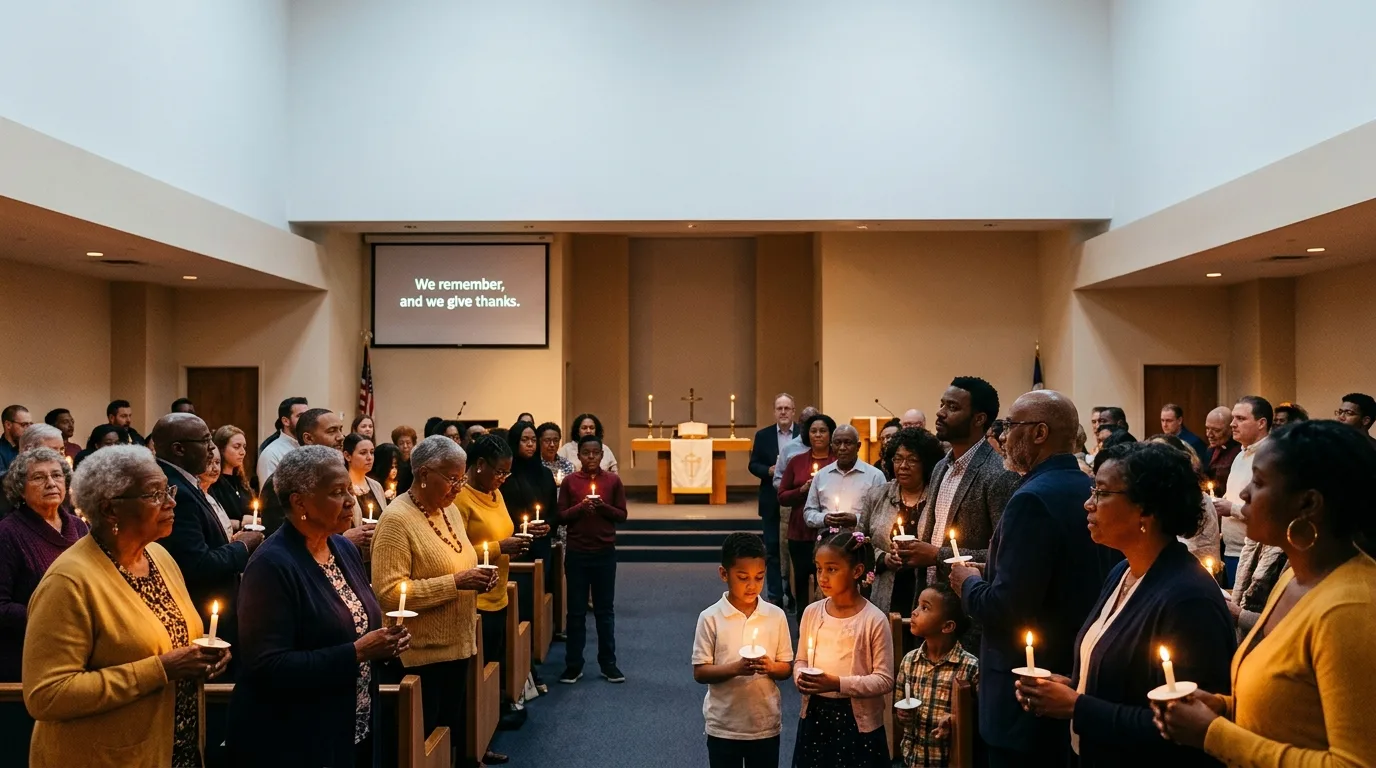
February is Black History Month, and for most congregations it is not one Sunday but four — sometimes five. Some years all of them fall in the season after Epiphany. In others, Ash Wednesday lands early, the last Sunday before it is Transfiguration, and the month ends in Lent. The prayers on this page were written so that none of that matters. They hold in either season, in any year, and they do not ask you to leave the lectionary.
This page carries prayers for Black History Month you can use as they are — a call to worship, a litany of the cloud of witnesses, a prayer of confession, and prayers of the people — and a free, complete liturgy built around them, with a four-Sunday candle frame for congregations that keep the whole month. Everything here is written for progressive, affirming, and mainline congregations, in expansive language, and it does not pretend the church was a bystander.
Two ways. The first is the highlight reel: a bulletin insert of famous names, a spiritual the choir learned for the occasion, and a sermon that admires the past tense. It is pleasant, and it costs nothing, which is the problem. The second is the opposite — a service so weighed down with lament and confession that the joy of the Black church, which was never permission-based, does not get a line.
So the prayers on this page do three things a generic Black History Month resource usually will not. The litany names the church's own witnesses — the ones who read Exodus in secret, the ones who walked out of a Methodist church rather than pray on their knees at the back of it, a priest and a march organizer who did not fit the categories the church offered — and it leaves a line for your own town's history. The confession puts the historically white church inside the story rather than beside it, and says out loud that a month is not an alibi. And the four-Sunday frame ends on joy, deliberately, because the last word of this month should not be sorrow.
One practical honesty: Dr. King's sermons, speeches, and the Letter from Birmingham Jail are under copyright, and the King estate enforces it. Nothing on this page reproduces them. What you will find here in full is scripture and public-domain spirituals — the Black church's own theology before anyone wrote it down.
The complete liturgy is free to download as a PDF and an editable Word document. Twelve pages: before-you-begin notes on the moving calendar, guidance for the worship planner, and practical notes — including what to do if your congregation is predominantly white and what not to ask of your Black members; a gathering with welcome, call to worship, and invocation; a scripture table of eleven readings that hold every year, with a note on the Slave Bible; a reading from Frederick Douglass, in the public domain; the litany of the cloud of witnesses; the four-Sunday candle frame; a confession and assurance, with a prayer of thanksgiving for the Black church for congregations that should pray that instead; prayers of the people; a short section for a Sunday in Lent; words for the table, a commissioning, and a blessing; five lines for a screen or bulletin; and music notes.
Every element in the Word file is a plain paragraph, so you can copy any prayer straight into your own bulletin or slide template. No attribution is required.
Download the free Black History Month liturgy
Hush Harbors: The Secret Churches Of Enslaved Black Christians
The four spoken pieces at the heart of the liturgy, ready to use. "One" is the leader; "All" is the congregation.
Hebrews 12 and Psalm 139 in echo.
One: We are surrounded by so great a cloud of witnesses —
All: the ones whose names we know, and the ones history did not write down.
One: They were fearfully and wonderfully made,
All: every one of them, in every shade God ever made.
One: Some were told otherwise — by law, by custom, by people who called themselves Christian.
All: God did not agree. God has never agreed.
One: Come and worship the God who sees, who hears, and who comes down.
All: We are surrounded. We are not alone. Amen.
A bell or singing bowl after each response, or a candle lit — one action per witness, the same action every time. Add the local line; do not skip it.
One: For the ones who read Exodus in secret, in the woods and the brush arbors, and believed it was about them:
All: We remember, and we give thanks.
One: For Absalom Jones and Richard Allen, who walked out of a Methodist church in Philadelphia rather than pray on their knees at the back of it, and built churches of their own that are still standing:
All: We remember, and we give thanks.
One: For the woman who stood up in a hall full of men and asked whether she was not also a woman; for the woman they called Moses, who went back for others again and again:
All: We remember, and we give thanks.
One: For the maids and the laborers who walked to work for a year in Montgomery, and the sharecropper from Mississippi who was beaten in a jail and testified anyway:
All: We remember, and we give thanks.
One: For Addie Mae, Cynthia, Carole, and Denise, who were in a church basement on a Sunday morning in Birmingham, and for every child who has ever been made to pay for what adults would not give up:
All: We remember, and we give thanks.
One: For the nine at Mother Emanuel, who opened the door to a stranger for Bible study:
All: We remember, and we give thanks.
One: For Pauli Murray, priest and prophet, who did not fit the categories the church offered and became a saint of it anyway; for Bayard Rustin, who organized the march and was pushed to its margins for whom he loved:
All: We remember, and we give thanks.
One: For the choir directors and the ushers, the mothers of the church, the deacons who kept the building open, the cooks and the drivers and the ones who taught the children — the ordinary saints of a church that carried this witness when no one else would:
All: We remember, and we give thanks.
One: For what happened here, in this place: [name the local history — the school, the church that split, the counter, the road, the neighborhood]:
All: We remember, and we give thanks.
One: For the ones whose names were never written down, and the ones we will learn next year:
All: We remember, and we give thanks. Set us in their company, and make us worth remembering. Amen.
Written in the first person for the historically white church. If your congregation is Black, the full liturgy carries a prayer of thanksgiving for the Black church to pray in its place. Prayed in unison.
God who sees,
we confess that the church has not always been a place
where your children were safe to be seen.
We printed Bibles with the Exodus torn out
and preached from what was left.
We split our denominations over whether a person could be owned,
and when we reunited, we drew the color line on the map again.
We kept the most segregated hour of the week
and called it tradition.
We admired the prophets after they were dead
and asked them to wait while they were living.
We put Black history on one Sunday in February
and white history on the other fifty-one, and called that neutral.
[Name your own church's or denomination's history here, briefly and truthfully.]
Forgive us.
Do not let us off with a month.
Make us the church that should have existed by now,
and give us the courage to become it in front of the people we failed.
Amen.
Silence is kept. Let it be longer than is comfortable.
One: Hear the good news: God saw Hagar in the wilderness, and she lived. God heard the people under Pharaoh, and they walked out. God shows no partiality — and that includes no partiality toward our despair.
All: We are forgiven. We are not excused from the work.
One: Both are true. Rise, and begin it.
The response is Hagar's name for God in Genesis 16 — an enslaved Egyptian woman, alone in the wilderness, the first person in scripture to give God a name.
One: For every person in this room who has been told, in any language, that they were not what God had in mind — by race, by body, by who they love, by where they were born —
All: You are the God who sees.
One: For Black congregations and Black clergy, who have carried this witness for generations without waiting for the rest of the church to catch up —
All: You are the God who sees.
One: For children who are taught a history with the hard parts removed, and for the teachers who put the hard parts back —
All: You are the God who sees.
One: For everyone whose vote is made harder to cast, whose neighborhood is policed like a threat and served like an afterthought, whose name is a reason to be stopped —
All: You are the God who sees.
One: For those who hold power over housing, courts, schools, and borders, that they would prefer justice to order —
All: You are the God who sees.
One: For the ones who are tired — tired of explaining, tired of being the first, tired of February —
All: You are the God who sees.
One: For this congregation: make us honest about our history, and useful in the present.
All: You are the God who sees. See us, and send us. Amen.
The welcome, the invocation, the four-Sunday candle frame, the prayer of thanksgiving for the Black church, the table words, the commissioning, and the blessing are in the full liturgy.
These readings hold every year, in either season. Choose two or three. For a list of verses with a short reflection on each, see Bible verses for Black History Month, in KJV and NRSVue.
For a Sunday in Lent, add Mark 15:21 — Simon of Cyrene, a North African, compelled to carry the cross — or Psalm 137:1–6, the song of a people asked to sing in captivity. Stop at verse 6.
"Lift Every Voice and Sing" is the hymn of the month. James Weldon Johnson wrote the words in 1900 and his brother J. Rosamond Johnson the music; it is in the public domain. Sing all three verses, standing. The third verse is the prayer, and a congregation that stops after the first has sung a march and skipped the church.
The spirituals were the Black church's own theology before anyone wrote it down, and nearly all of them are free to sing: "Go Down, Moses," "Wade in the Water," "There Is a Balm in Gilead," "Swing Low, Sweet Chariot," "This Little Light of Mine," "Ain't Gonna Let Nobody Turn Me Around," and — for a Lenten Sunday — "Were You There," "Guide My Feet," and "I Want Jesus to Walk with Me." "We Shall Overcome" entered the public domain after a 2018 court settlement. "Precious Lord, Take My Hand" is beloved and under copyright; sing it from a licensed hymnal.
One rule worth keeping: do not borrow music you do not sing the rest of the year. If your congregation has never sung a spiritual, February is the month to start, not the month to perform one.
Say so from the front, plainly and without apology, before the confession. It is the reason the prayer takes the shape it does, and naming it keeps the prayer from sounding like it is about someone else.
Three more things worth deciding before the first Sunday. Do not ask the Black members of your congregation to be the program; they did not join in order to be February. Do not invite a Black preacher or choir for this one month unless a relationship already exists the other eleven — a guest brought in for the occasion will know exactly what is happening. And direct the offering, or a second offering, to a local organization doing the work the prayers name, and say where it is going before the plates go out.
In years when Ash Wednesday comes early, one or more of February's Sundays will be Lenten and the Sunday before it will be Transfiguration. The liturgy needs no rewriting — the confession is already Lenten, and the witnesses do not change with the season. Omit any alleluia, keep the color purple rather than adding a color for the month, and resist the obvious Transfiguration sermon: the mountaintop is not a metaphor you need to borrow, and the text is about coming back down. So is this month.
Slides, graphics, and backgrounds for February — including Pieced Together, a raised fist made of patchwork quilt fabric, and the African Fabric and Beyond Black History Month PowerPoint sets — are gathered in the African-American Experience collection. If your congregation marks MLK Sunday in January, the MLK Sunday prayers and liturgy are built to lead into this month, and our MLK Day church graphics cover the slides and flyers for that weekend; the Watch Night service guide covers Freedom's Eve, two weeks before that.
Planning a program rather than a service? Our Black History program ideas for church has a sample order, welcome speeches, and the Occasion.
Writing your own sermon or prayers for the month? PCM Lumen drafts sermons, liturgy, and pastoral letters in a progressive voice, and PCM Imago generates worship images with affirming presets built in.
Is there a set Sunday for Black History Month in church?
No. Black History Month is the whole of February, and congregations mark it on one Sunday, several, or all of them. The liturgy on this page is written for any February Sunday and includes a four-Sunday candle frame — Origins, Witnesses, Lament, Joy — for congregations that keep the whole month.
What if Lent begins in February?
Ash Wednesday moves, and in some years it falls before the month is half over. Nothing in this liturgy depends on the season. For a Lenten Sunday, omit any alleluia, keep the color purple, and add Mark 15:21 or Psalm 137:1–6; the liturgy includes a short section on exactly this.
Can we quote Dr. King in worship?
His speeches, sermons, and the Letter from Birmingham Jail are under copyright and the King estate enforces it. Short phrases in common currency are fine; longer readings should come from a licensed source, credited. This liturgy quotes none of it, and uses scripture, Frederick Douglass, and public-domain spirituals for the words it prints in full.
Is the confession appropriate for a Black congregation?
No — it is written in the first person for the historically white church, and the full liturgy says so. It carries a prayer of thanksgiving for the Black church to use instead, and a note for multiracial congregations on how to decide.
Is "Lift Every Voice and Sing" in the public domain?
Yes. The words (James Weldon Johnson) and music (J. Rosamond Johnson) date from 1900. "We Shall Overcome" is also in the public domain following a 2018 court settlement, and the spirituals listed on this page are free to sing.
Is the liturgy really free?
Yes. Download it as a PDF and an editable Word document, print it, project it, and adapt it. No attribution is required, though it is always welcome.