No products in the cart.
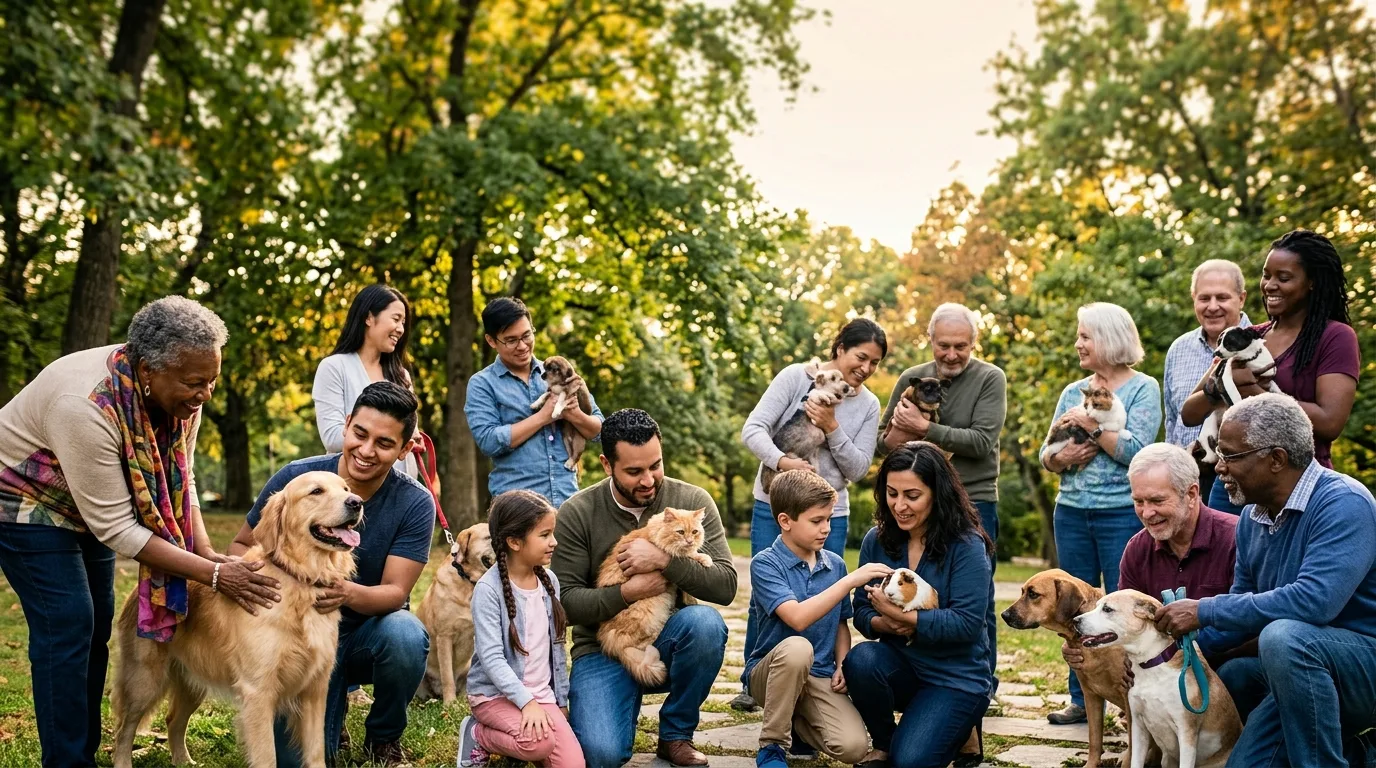
Blessing of the Animals is a short rite for the Feast of St. Francis. People bring the animals they live with, the congregation gives thanks for creatures, and everyone is reminded that being a creature is not a lesser thing to be. It fits inside a regular Sunday service in fifteen or twenty minutes, or stands alone outdoors.
October 4, 2026 falls on a Sunday. Congregations that normally shift this observance to the nearest Sunday do not have to this year — the feast lands on the day itself.
What follows is a complete liturgy, free to use. Print it in your bulletin, project it, read it aloud, change the words that do not sound like your congregation. Take all of it or take three pieces. No attribution required.
One note on what you will find here that you may not find elsewhere. Most Blessing of the Animals services are entirely joyful, and for a good number of people in the pews that is not the whole truth. Someone in your congregation buried an animal this year. Someone had to make the decision and is still turning it over. This liturgy includes a remembrance and a blessing for an animal you could not save, alongside everything else.
EVERY PIECE IS OPTIONAL: The call to worship, the blessing, and the sending make a complete rite on their own. Add the litany, the confession, or the remembrance as your service allows.
A word of welcome
Welcome. However you arrived here today — with a dog pulling at the leash, a cat protesting from a carrier, a photograph in your pocket, or nothing at all but the memory of an animal you loved — you are welcome.
This is a service about creatures. All of us are creatures. That is where we begin.
Call to worship
One: God of every living thing,
All: you made the wide earth and called it good.
One: You made what swims and what flies, what runs and what burrows,
All: and you did not ask them to be useful to be worthy.
One: You made us, too — breathing, hungry, mortal,
All: kin to every creature that shares this fragile world.
One: So we come with our animals and our memories,
All: to bless and to be blessed. Amen.
Holy One, you spoke into being the whale and the wren, the working dog and the barn cat, the creatures we have named and the ones we will never see.
You did not make them for us. You made them for yourself, and for their own sake, and then you set us among them and asked us to keep watch.
We have not always kept it well.
Be with us this morning. Steady the anxious animals and the anxious people. Open us to the ordinary holiness of a creature who trusts us.
Amen.
| Reading | Why it fits |
|---|---|
| Genesis 1:20–25 | Sea creatures, birds, and land animals are each called good before humanity appears at all. Worth naming out loud. |
| Genesis 9:8–17 | The covenant after the flood is made with every living creature, and says so five times in ten verses. The rainbow is not a promise to humanity alone. |
| Job 12:7–10 | Ask the animals and they will teach you. Short, and it reverses who is instructing whom. |
| Psalm 104:10–24 | God provides for wild goats, birds, lions, and creatures of the sea — none of them useful to us. |
| Psalm 148 | Sea monsters, wild animals, cattle, and creeping things all called to praise. A good congregational read. |
| Matthew 6:26 | Consider the birds. The plainest option when the service is already full. |
| Luke 12:6 | Not one sparrow is forgotten in God’s sight. Pairs well with the remembrance. |
A note on Genesis 9. If you preach on it, the covenant language is worth naming plainly: God makes the promise with every living creature of all flesh, and repeats it five times in ten verses. The rainbow is not a promise to humanity. It is a promise to the whole living world, and we are included in it rather than being the point of it.
One: For animals who work beside us — who herd and guard, who guide the blind and steady the panicking, who search the rubble and find the lost:
All: We give thanks.
One: For animals who ask nothing but food and warmth, and give back more than they were asked:
All: We give thanks.
One: For the wild ones we will never touch — the hawk on the wire, the fox at the treeline, the whale in water we will never swim:
All: We give thanks.
One: For animals who came to us broken, from shelters and roadsides and situations we do not like to imagine:
All: We give thanks.
One: For creatures who were here long before us and will remain long after:
All: We give thanks.
One: For every creature whose name we do not know, in waters we have not mapped and forests we have not walked:
All: We give thanks, and we ask forgiveness for what we have taken from them.
Optional. Some congregations will want this; some will find it too heavy for a joyful morning. Read your room.
God of the living world, we confess that we have treated your creation as inventory.
We have called ourselves stewards and behaved like owners. We have made comfortable arrangements that cost creatures their habitats and their lives, and we have arranged not to think about it.
We confess that we love the animals in our homes more easily than the ones in our food systems, and that we have let that inconsistency go unexamined because examining it would ask something of us.
Forgive us. Turn us toward repair. Make our love for the creature at our feet the beginning of something larger, and not the end of it.
Amen.
Assurance
Hear the promise made after the flood: God's covenant is with every living creature, and it does not depend on our getting it right. We are forgiven. We are also still responsible. Both are true. Go gently, and begin again.
Introduction
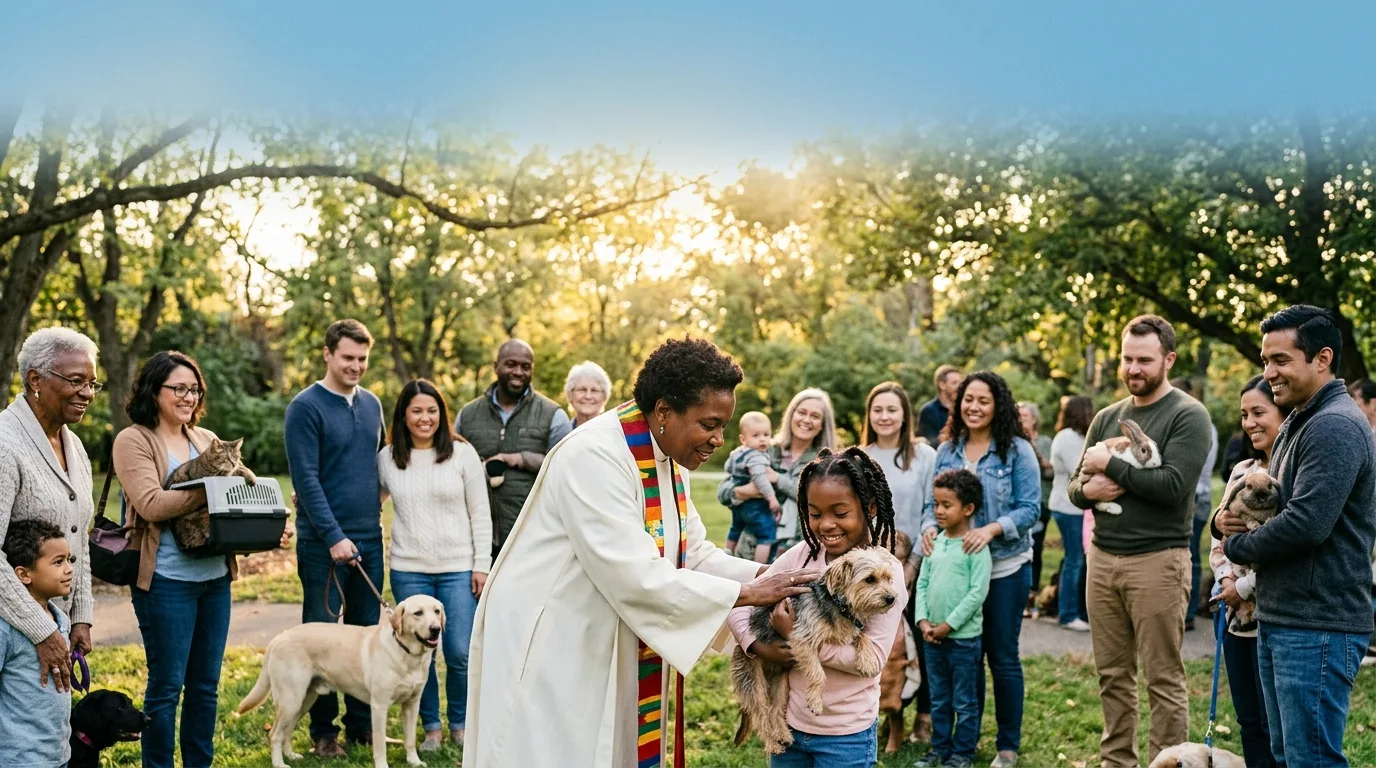
In a moment I will move among you. If your animal is nervous, stay where you are and I will come to you. If your animal cannot be here, hold the photograph or the collar or the leash, and I will bless that just the same. If you are holding nothing, hold out your hands.
For an individual animal
Use the animal's name. It matters more than anything else in this liturgy.
[Name], creature of God, you are loved by the One who made you. May you be safe, and well, and unafraid. May you be gentle with those who are gentle with you. And may the love between you and those who care for you be a small, true picture of the love that made the world.
For an animal who is ill or elderly
[Name], God knows your body is tired. May your days be free of pain. May you be surrounded by the people who love you for as long as you have, and may you know, in whatever way a creature knows, that you have been a good companion and you are not alone.
For an animal who has died
We remember [Name], who filled a particular space in this household that nothing else will fill.
Thank you for the years. Thank you for the ordinary mornings.
God of every living thing, hold what we cannot hold, and be gentle with those who are grieving an animal and have been told, by someone who meant well, that it was only a pet.
It was not only anything.
For an animal we could not save
For creatures who came to us too late, or too hurt, or who we had to let go of when we were not ready:
God, we did what we could. Where we did not, forgive us. Where we did, let that be enough. Amen.
Collective blessing
If individual blessing is impractical, or to close the individual blessings.
Creatures of God — furred and feathered and scaled, present and absent, living and remembered — may you be blessed.
May you be fed and watered and kept from harm. May you be spoken to kindly. May you be, as you have always been, good in God's sight — not because of what you do for us, but because you are.
Amen.
Invite people to say aloud the name of an animal who has died. Leave more silence than feels comfortable. The names will come slowly and then all at once.
We name them now.
(silence, and names)
Every one of them was known to God before they were known to us. Every one of them is held.
One: You who feed and walk and clean up after —
All: we take up the work of care.
One: You who foster and rescue and drive the long way to the shelter —
All: we take up the work of care.
One: You who work for the wild places, the waters, the birds on the flyway —
All: we take up the work of care.
One: You who cannot keep an animal, and love them anyway —
All: we take up the work of care.
One: Go into a world that is groaning,
All: and be gentle in it. Amen.
Go now with your animals. Go with your photographs and your grief and your good memories.
The God who made the sparrow and counts them still goes with you, keeps you, and calls you — every creature of you — good.
Go in peace.
Check what is in your congregation's hymnal and licensed for your context. Titles only; PCM does not license music.
Many congregations send everyone home with a card or a medal for a collar — a small thing that stays visible. These four texts are free to print, with or without your church's name added.
Business-card stock works, and a hole punch in the corner turns one into a collar tag. For animals who are not here, the same card in a bulletin is something to keep.
The Feast of St. Francis is October 4, which is a Sunday in 2026 — so it can be held on the day itself rather than moved. Congregations that prefer a Saturday outdoor service often use the day before.
Thirty minutes is generous. Animals will tell you when it is time to stop, and the service is better for ending while everyone is still enjoying it.
Say this out loud, more than once. Some animals cannot travel, some people lost one this year, and some love animals they cannot keep. Photographs, collars, and empty leashes are full participation, and the liturgy is written to make that explicit rather than to treat it as a consolation.
Water and shade if you are outdoors. Leashes, crates, and carriers requested in writing beforehand. A plan for the dog who barks through the entire thing — and the plan is to let the dog bark. This is a service about creatures being creatures.
The litany gives thanks for working animals, wild creatures, and rescued animals. Congregations with farmers, veterinarians, shelter volunteers, wildlife rehabilitators, or service-dog handlers should name them. It stops the service being only about pets and starts making it about creation.
The prayer of confession names our inconsistency about the animals we love and the animals we eat. Some congregations will find it exactly right. Others will find it too heavy for a joyful morning with children present. Read your room; there is no wrong answer.
Blessing of the Animals Mini Movie - A short worship video for the gathering or the blessing itself, in English and Spanish.
Blessing of the Animals Flyer & Poster - Fully editable template — set your own date, time, and location, in any language.
Join PCM Complete -Worship slides, backgrounds, and seasonal sets for every Sunday of the year, built for progressive and affirming congregations.
Try PCM Lumen - Our AI companion for progressive ministry. Use Lumen to adapt this liturgy for your congregation's voice. Try it free for 14 days.
Free Worship Backgrounds - Backgrounds and slides at no charge, for this service and the rest of the year.
When is the Blessing of the Animals in 2026?
The Feast of St. Francis of Assisi is October 4, which falls on a Sunday in 2026. Congregations that usually move the observance to the nearest Sunday can hold it on the day itself this year.
What happens at a Blessing of the Animals service?
People bring the animals they live with, the congregation gives thanks for creatures, and each animal is blessed by name. Most services run fifteen to thirty minutes and are held outdoors or in a sanctuary, with photographs and collars welcomed for animals who cannot attend.
What do you say when blessing an animal?
A short blessing using the animal's name works best. A full text is on this page, free to use, including blessings for an animal who is ill or elderly, for an animal who has died, and a collective blessing for congregations where individual blessing is impractical.
Can we hold a Blessing of the Animals indoors?
Yes. The liturgy is written to work in a sanctuary or outdoors. Indoors, ask for carriers and short leashes, and consider a collective blessing rather than moving among the pews.
What if someone's animal has died?
The liturgy includes a remembrance where animals who have died are named aloud, and a blessing for an animal you could not save. Grief for an animal is treated as real grief rather than a footnote.
Can we reprint this liturgy in our bulletin?
Yes. Reprint it, project it, adapt it, or rewrite it for your context. No permission notice or attribution is required.