No products in the cart.
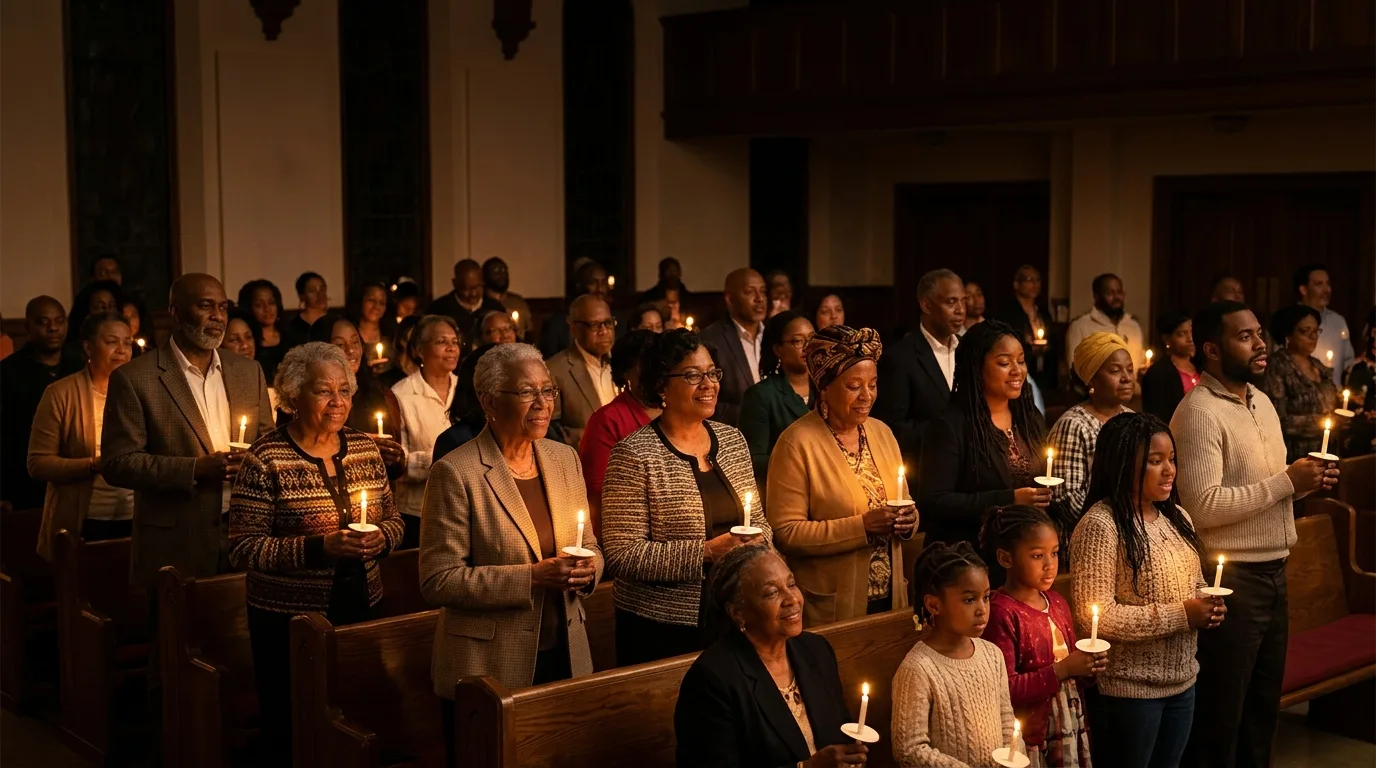
On the last night of 1862, people gathered in churches, praise houses, and cabins across the country and waited for midnight. The Emancipation Proclamation was set to take effect on January 1, 1863, and nobody in those rooms knew for certain what the morning would bring. They prayed the night through. More than a century and a half later, congregations are still gathering on December 31 to do the same thing.
This is a planning guide for Watch Night — where the service comes from, what belongs in it, and how to build one that is worth staying up for. It is written for pastors and worship planners in progressive and affirming congregations, including the many mainline churches that hold Watch Night without always knowing why they do.
A Watch Night service is a worship service held late on New Year's Eve. It usually begins somewhere between 7:00 and 10:00 p.m. and ends shortly after midnight, so that the congregation crosses from one year into the next together rather than alone.
The shape is looser than a Sunday morning. Preaching, congregational song, extended prayer, and testimony all have room to run. In many Black churches the last stretch before midnight is spent on your knees, and the first minutes of the new year are spent in praise. In many United Methodist and Moravian congregations the same hour is spent renewing a covenant. The two are not competing versions of the night. They are two branches of one root.
President Lincoln issued the preliminary Emancipation Proclamation on September 22, 1862, announcing that enslaved people in states still in rebellion would be declared free on the first day of the coming year. That gave the country one hundred days of waiting, and it gave December 31 a weight it has never lost.
On that night, free and enslaved Black Americans gathered — in churches where they could, in homes and hush harbors where they could not — to watch the hours until the proclamation took effect. Word traveled unevenly. Some communities learned at midnight, some at dawn, some much later. The gathering itself became the tradition, and it has been kept every year since as Freedom's Eve.
It is worth telling this history accurately from the pulpit rather than sentimentally. The proclamation applied to the Confederate states in rebellion. It did not free anyone in the loyal border states, and it could not be enforced anywhere the Union Army had not yet reached — which is why Juneteenth exists as a separate observance two and a half years later. The people who gathered that night were not naive about the distance between a document and deliverance. They watched anyway. That is the theological content of Watch Night, and it is more useful to a congregation than a tidier story would be.
The call-and-response many congregations use as midnight approaches — a voice asking the hour, a voice answering — comes from Isaiah 21:11–12, where a watchman is asked what remains of the night and answers that morning is coming, and the night with it.
If your congregation has never used it, this is the single most transferable piece of the tradition. It costs nothing, it needs no rehearsal, and it puts the whole meaning of the night into ninety seconds.
Watch Night did not begin in 1862. It began among the Moravians in the early eighteenth century as a vigil for reflecting on the year ending and the year beginning. John Wesley adopted the practice for the Methodists, who kept watch-night vigils regularly rather than once a year, and in 1755 he introduced a Covenant Service in which the congregation renewed its commitment to God together.
Black Methodists carried both traditions, and after 1862 the vigil and the covenant fused with the memory of Freedom's Eve. This is why a United Methodist congregation planning a Watch Night service is not borrowing someone else's tradition, and why an AME or AME Zion congregation is not observing a merely cultural holiday. It is one inheritance with two histories inside it.
If your congregation is United Methodist, the Covenant Renewal Service in The United Methodist Book of Worship is the standard text, and it is written for exactly this night. Many congregations use it on December 31 and others move it to the first Sunday of the year.
A note on naming. Congregations call this night Watch Night, Watchnight, Freedom's Eve, or Covenant Renewal, and the name you print carries meaning. If your congregation is predominantly white and has not observed Freedom's Eve before, name the history in the service rather than only on the bulletin cover. Borrowing the title without the story is the failure mode worth avoiding.
Watch Night 2026 falls on Thursday, December 31, 2026, with the service beginning that evening and ending after midnight on Friday, January 1, 2027.
December 31 is the seventh day of Christmas, so liturgically the night sits inside Christmastide and the paraments stay white or gold. Some congregations dress the space for Freedom's Eve instead, with kente cloth or red, black, and green, and there is no conflict in doing so — Watch Night is a devotional service rather than a fixed feast, and local practice governs.
The Sunday following is January 3, 2027, the Second Sunday after Christmas. If you are planning the whole arc, the readings for the Sunday before are on the First Sunday after Christmas, December 27, 2026.
Watch Night runs long by design, and the risk is not that people leave early — it is that the middle sags and the congregation arrives at midnight tired rather than expectant. The structure below builds in a deliberate change of energy roughly every ninety minutes. Adapt the clock to your start time.
| Time | Movement | What happens |
|---|---|---|
| 7:00 p.m. | Gathering | Music as people arrive, greeting, and a short framing of why the congregation is here tonight rather than only that it is New Year's Eve. Name Freedom's Eve in the first ten minutes. |
| 7:30 p.m. | The Word | Scripture and the main sermon, while the room is fresh. Preaching later than this fights the hour. |
| 8:45 p.m. | Testimony | Open time for members to speak about the year ending. The most memorable hour of the night in most congregations, and the one most often cut for time. Protect it. |
| 10:00 p.m. | Fellowship | A break with food. Watch Night has always been as much table as sanctuary. |
| 10:45 p.m. | Watching | Return to the sanctuary. Song, extended prayer, and — where your tradition uses it — the Covenant Renewal Service or a litany of remembrance for members who died this year. |
| 11:45 p.m. | The turn | The watchman call-and-response, then silence or kneeling prayer into the final minutes. The countdown belongs here, on screen, quiet. |
| 12:00 a.m. | Praise | Break the silence at midnight. Communion, a blessing for the new year, and singing on the way out. |
Watch Night has no assigned lectionary readings, which makes the selection a real editorial choice. These carry the night's two themes — vigil and freedom — without forcing them.
The music does more work on this night than on any other, because it carries the congregation across four or five hours and one year boundary. A workable pattern is to open wide, go quiet before midnight, and let it break loose afterward.
We've Come This Far by Faith, How I Got Over, Total Praise, and Goodness of God are all in wide Watch Night use and all under copyright. Confirm coverage under your CCLI or OneLicense account before projecting lyrics — the reporting matters as much as the license, and Watch Night is the service most likely to be missed in a year-end report because it does not fall on a Sunday.
Watch Night is the one service in the church year that ends on a literal countdown, and the screen is doing something real at 11:59. Most New Year's church media is champagne and confetti, which is fine for a party and wrong for this room. PCM's African-American Experience collection is built for congregations that need the other thing — Freedom's Eve imagery, Lift Every Voice slides, and worship backgrounds that hold up under low sanctuary light.
A PCM Complete membership covers every download for the year, which is the sensible route if you are also planning Martin Luther King Jr. Sunday and Black History Month in the same eight weeks. If all you need is the last sixty seconds, our free church countdown timer will get you to midnight.
Get PCM Complete for the year Or browse the African-American Experience collection and the countdown timers on their own.If you are planning this service in a congregation that has said out loud that LGBTQ+ people belong here, the last hour of the year is a place to say it again rather than assume it carried over.
Some of the people in the room came out this year and are ending the year with a smaller family than they started it with. Some spent the year watching legislatures debate whether their children should exist. Some are watching for a morning that has not come and are being asked, on this night of all nights, to be hopeful about it. Watch Night was built by people in exactly that position, and it did not require them to pretend. It asked them to stay in the room and keep watch together.
So say it plainly during the testimony hour or the prayers: name who is still waiting, and name that they belong here while they wait. The tradition can hold it. That is what it was for.
One thing worth doing this year. Read the names of members who died in the past twelve months during the watching hour, before midnight rather than after. Families plan their entire New Year's Eve around whether the church will remember, and Watch Night is the service where remembering fits.
PCM Lumen drafts liturgy, prayers, and sermon material inside a progressive and affirming frame rather than correcting for one afterward, and PCM Imago generates worship imagery with inclusive presets built in. Both are useful when a service like this one has no published order to start from.
Try PCM Lumen free for 14 days United Methodist? There is a version tuned to UMC language and worship order.
Video loops, PowerPoint template and graphics. All affirming. All in English and Spanish.
Is Watch Night the same as a New Year's Eve service?
Not quite. Every Watch Night service is held on New Year's Eve, but not every New Year's Eve service is a Watch Night. Watch Night carries a specific history — the Moravian and Methodist vigil tradition, and Freedom's Eve on December 31, 1862 — and it ends by crossing midnight in worship rather than closing before it.
When is Watch Night service 2026?
Thursday, December 31, 2026. Most services begin between 7:00 and 10:00 p.m. and end shortly after midnight on Friday, January 1, 2027.
Why is Watch Night important in Black churches?
On December 31, 1862, free and enslaved Black Americans gathered in churches and homes to wait for the Emancipation Proclamation to take effect at midnight. That night is remembered as Freedom's Eve, and Watch Night has been kept annually ever since as both a vigil and a remembrance of emancipation.
What is the difference between Watch Night and a Covenant Renewal Service?
They share a root. John Wesley adopted the Moravian watch-night vigil for the Methodists and introduced a Covenant Service in 1755. Many United Methodist congregations use the Covenant Renewal Service from the Book of Worship as the second half of their Watch Night service.
How long does a Watch Night service last?
Typically three to five hours, often with a fellowship meal partway through. A 7:00 p.m. start with a midnight close is common.
What color are the paraments for Watch Night?
December 31 is the seventh day of Christmas, so white or gold is liturgically correct. Some congregations dress the space for Freedom's Eve instead, with kente cloth or red, black, and green. Watch Night is a devotional service rather than a fixed feast, so local practice governs.
What scriptures are read at Watch Night?
There are no assigned lectionary readings. Common choices include Exodus 12:41–42, Isaiah 21:11–12, Psalm 130:5–6, Isaiah 43:18–19, Luke 4:16–21, and Revelation 21:1–5.