Advent begins in the dark. These 34 copy-and-paste AI prompts generate worship backgrounds, sermon slides and social graphics for all four Sundays of Advent, Christmas Eve, and the twelve days of Christmastide — written for congregations that keep Advent as a season of waiting rather than a four-week run-up to Christmas.
Every prompt involving a biblical figure asks for first-century Middle Eastern people with brown skin and dark hair. Image models render these scenes with European features unless told otherwise, so that instruction is doing real work — leave it in when you copy.
Copy a prompt, drop it into PCM Imago or any AI image tool, and have a finished slide in under a minute.
Name the liturgical colour you actually use
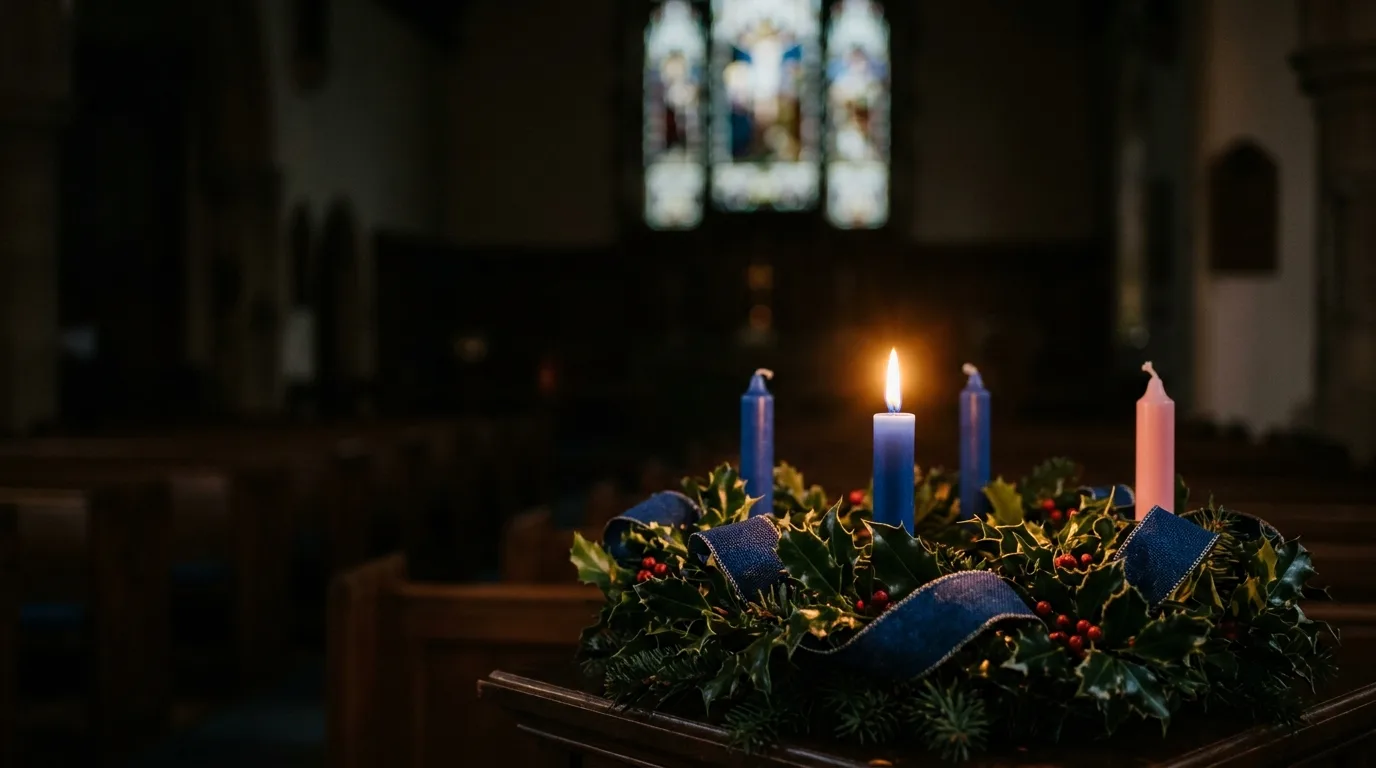
Most models default to purple for Advent. If your congregation uses Sarum blue, add “deep blue rather than purple” to any wreath or candle prompt — otherwise you will get purple every time and wonder why.
Leave room for your text
The phrase “sermon slide composition with text space” is in many of these prompts on purpose. It tells the model to keep an area uncluttered so a scripture reference, hymn title or sermon heading can sit on top without a second pass in Canva.
Keep the season honest
If you want an Advent 1 image that still reads as Advent rather than Christmas, add “unlit,” “before dawn,” or “waiting” and remove anything festive. The restraint is the point — and it is what makes the image usable on the first Sunday rather than the fourth.
Ask for the whole set at once
Requesting all four Advent Sundays in a single message produces four images in one visual style. Asking one at a time produces four unrelated ones. This is the most common reason a set looks incoherent on screen.
When does Advent 2026 begin?
Advent 2026 begins on Sunday 29 November and runs four Sundays: 29 November (Hope), 6 December (Peace), 13 December (Joy), and 20 December (Love). Christmas Eve falls on Thursday 24 December. The liturgical year that begins with Advent 2026 is Year B in the Revised Common Lectionary.
What AI prompts work for Advent worship slides?
Prompts that name the specific Sunday and the mood it carries, rather than generic Christmas imagery. Advent 1 wants darkness and a single flame; Advent 3 wants the rose candle and the Magnificat. Every prompt on this page is written for the day it names and can be copied straight into your AI tool.
How do I get Advent images that are not just Christmas images?
Add words like “unlit,” “before dawn,” or “waiting,” and remove anything festive. Most stock and AI imagery collapses Advent into Christmas by the first Sunday. Keeping the season honest visually — dark, expectant, not yet arrived — is what makes an image usable on Advent 1 rather than only on the fourth Sunday.
Why do these prompts specify Middle Eastern features?
Because image models render biblical scenes with European features unless told otherwise. Mary, Joseph and Jesus were first-century Middle Eastern people with brown skin, and the instruction in each prompt is what produces an image that reflects that. Leave it in when you copy the prompt.
Can I use these prompts for Christmas Eve and Christmas Day?
Yes. Ten of the 34 prompts cover Christmas Eve and the twelve days of Christmastide, including the nativity, the shepherds, the magi, and the flight into Egypt. Christmastide runs to 5 January, and most churches stop making graphics on 26 December.
Which AI tools do these prompts work with?
All of them. They are written in plain descriptive language rather than tool-specific syntax, so they work in Google Gemini, ChatGPT, Midjourney, DALL·E, Adobe Firefly and PCM Imago. No account or download is needed to use the prompts on this page.
Should Advent candles be purple or blue?
Both are used. Purple is the older Western practice, shared with Lent; Sarum blue is widely used across mainline and progressive congregations to distinguish Advent's expectancy from Lent's penitence. Most AI models default to purple, so add “deep blue rather than purple” if blue is what your sanctuary uses.