No products in the cart.
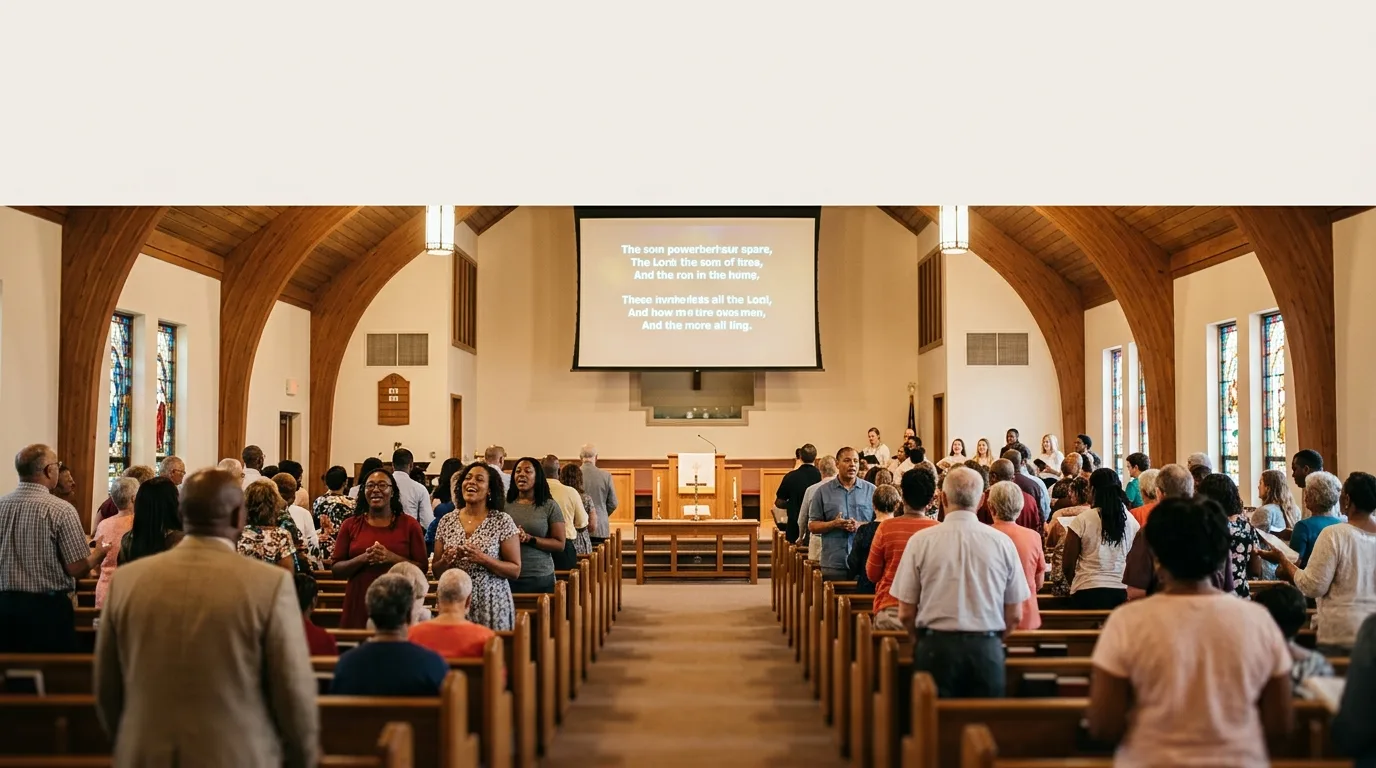
Somewhere this Sunday, a congregation will sing a beloved hymn from a screen, under a license that doesn't cover it — and nobody in the building will know.
This is not usually negligence. It's the result of a genuine and very reasonable confusion. Most churches have heard of one licensing organization, they signed up, and they assumed the box was checked. For a great many mainline and progressive congregations, it wasn't — because the license they bought was built for a repertoire they don't sing.
Here is what's actually going on, in plain language, and a short audit you can finish before your next worship meeting.
One honest caveat up front: this is orientation, not legal advice. We're a worship media company, not a law firm. Everything below points you toward the people who can answer definitively for your congregation.
There is a difference between performing music and reproducing it, and copyright law treats them very differently.
U.S. copyright law includes a narrow exemption for religious services. Your congregation can sing a copyrighted hymn during worship without a performance license. That much is genuinely covered.
What the exemption does not cover is reproduction — and reproduction is a bigger category than most people assume. Printing the words in a bulletin is reproduction. Photocopying an octavo for the choir is reproduction. And putting the text on slides and on a screen is reproduction. So is emailing the text to your congregation, and so is embedding it in a video.
Buying hymnals doesn't change this. Purchasing a book grants you the book. It does not grant you the right to copy what's inside it onto anything else. This surprises people, reasonably — it feels like you already paid — but the two are separate transactions in the eyes of the law.
So: your choir singing it is fine. Your screen showing it is a licensing question.
Both major licensing bodies sell you essentially the same permission. What differs is whose music they can grant it for.
CCLI — Christian Copyright Licensing International — administers the Church Copyright License. It covers projecting lyrics, printing them in bulletins and song sheets, making your own arrangements where no published version exists, and recording live worship music. Its catalog is enormous and it is weighted heavily toward contemporary worship publishers. If your church sings a lot of Hillsong, Bethel, and Capitol CMG material, CCLI is very likely the license you need.
ONE LICENSE exists because that wasn't the whole church. It aggregates the catalogs of the major Catholic and mainline Protestant publishers — the houses that produced most of what sits in a mainline hymnal and its supplements. If your Sunday morning draws on GIA, OCP, Augsburg Fortress, Hope, or Church Publishing, this is very likely the license you need.
The failure mode is now visible. A UCC or Episcopal or ELCA congregation hears "churches need CCLI," buys CCLI in good faith, and projects hymn texts every week from publishers CCLI cannot license on their behalf. The license is real. It's just pointed at somebody else's repertoire.
Plenty of congregations need both. Some need neither, because everything they project is old enough to be free. The only way to know is to look at what you actually sing — which is the audit at the end of this piece.
A myth worth killing while we're here: if a song isn't in a licensing catalog, that does not mean it's free. It means that license doesn't cover it and you'd need to go to the copyright holder directly.
This is the part that catches even careful churches, and it matters more the more liturgical you are.
If you project a setting of the Kyrie, a eucharistic prayer, a confession and words of assurance, a psalm setting — those texts have authors and publishers too, and a hymn license doesn't automatically reach them.
Lutheran congregations are the clearest case. Augsburg Fortress liturgical texts are not included in ONE LICENSE. Augsburg handles them through its own Liturgies License, which comes bundled with a Sundays and Seasons subscription or can be purchased on its own. There's a narrower Evangelical Lutheran Worship Liturgies License covering just the ELW family of resources. An ELCA congregation projecting the liturgy and the hymns may genuinely need two licenses from two organizations.
Episcopal congregations have a somewhat easier time of it — Church Publishing participates in ONE LICENSE, and a RiteSong subscription carries certain permissions on its own. The prayer book text is widely treated as free to reproduce; the contents of The Hymnal 1982 are a separate question, hymn by hymn. That's worth a direct conversation with Church Publishing rather than an assumption either way.
And one more that catches nearly everyone: scripture translations are their own licensing question entirely. The music licenses don't cover them. If you're projecting readings, check your translation's permissions.
This is where mainline churches have a real and underappreciated advantage — and also where the most confident wrong answers live.
As of January 1, 2026, works published in the United States in 1930 or earlier are in the public domain. Works from 1931 join them on January 1, 2027, and the line advances one year every New Year's Day. That sweeps in an enormous amount of the traditional hymn repertoire. Much of what a mainline congregation sings on an ordinary Sunday is genuinely free to print, project, alter, and post.
But here is the trap.
A hymn is not one copyright. It's up to three. The text, the tune, and the harmonization can each be owned separately, by different publishers, with different dates. A hymn can have a public domain tune and a copyrighted text. It can have an ancient text in a copyrighted modern translation. It can have both free and sit inside a hymnal arrangement that isn't.
So "it's an old hymn" is not a finding. The specific text you are about to put on a slide, in the specific version you are about to use it, is the unit of analysis. The credit line at the bottom of the hymnal page is where you look. No copyright line generally means public domain. A copyright line means somebody owns that element and you need to know whether your license reaches them.
Explore copyright myths about Christmas that churches need to know →
And scanning the hymnal page itself is never the answer, even for a public domain hymn — you'd be reproducing a copyrighted typesetting. Set the text yourself.
For progressive and mainline congregations this is not a marginal question. It is a weekly one. Degendering divine language, replacing "Father" with "Creator" or "Holy One," updating language that has aged badly, swapping out imagery that no longer says what the congregation means — this is ordinary, careful, theologically serious work in a great many churches.
The copyright answer is clear, and it is not the one most people expect.
If the text is in the public domain, change it however you like. Print it, project it, publish it, sing it. It's yours. Given how much of the traditional repertoire is now public domain, this covers a lot of ground — and it's the single best argument for knowing exactly which of your hymns are free.
If the text is under copyright, a reprint license does not give you the right to alter it. Not CCLI, not ONE LICENSE, not a denominational liturgies license. Those licenses grant reproduction of the text as written. Changing the words creates a derivative work, which is a separate right, and it stays with the copyright holder. The Augsburg Fortress liturgies license, for example, says so explicitly: no adaptations, no translations, no new arrangements.
But there's a genuinely useful distinction underneath that, and the United Methodist Church's Discipleship Ministries has laid it out clearly for years: copyright governs the written and reproduced use of a text, not the spoken one.
Which means a worship leader can stand up and say "this morning, let's sing 'God who began a good work in you'" — and the congregation can sing whatever it chooses. That's not a reproduction. Nothing was copied. You can pencil the change into the margin of your own hymnals and choir copies, too.
What you cannot do is put the altered words in the bulletin or on the screen. That's the copy.
It's an awkward line. It's also, for now, the line. And the third option remains open: write to the copyright holder and ask. Publishers say no more often than not on inclusive-language edits, but the request costs a stamp and you're no worse off for having asked. Some texts have authorized inclusive-language versions already — worth checking before assuming you need to make your own.
Buying the license is step one. There's a step two, and it's the one that quietly goes undone.
ONE LICENSE requires you to report what you use. Under an annual license, you report what you reprinted or projected for the congregation. Under a podcast/streaming license, the bar is higher: you report all the music in the service, not just the congregational pieces. This is how royalties reach the composers and text writers who wrote the music your congregation sings. Reporting is done online through your account and takes a few minutes a week.
Practices differ by licensor. Augsburg Fortress, to simplify things, does not require churches to report usage of the liturgy texts it administers.
The practical upshot: reporting isn't paperwork for its own sake. It's the mechanism by which the person who wrote your congregation's favorite communion setting gets paid. Skipping it doesn't save money — it just moves it away from composers.
You also need the credit line on the slide. Song title, writers, copyright notice, and your license number. It only has to appear once per song, so the last slide of the hymn is fine.
If your service goes online in any form — livestream, recorded and posted, a link in the Friday email — assume your in-person license does not cover it and check.
Both organizations sell streaming permissions separately. And an important wrinkle on the ONE LICENSE side: not every member publisher has opted into podcast/streaming permissions, so a title you may lawfully project in the room might not be one you may lawfully stream. Reprint and streaming are checked separately, title by title.
Watch your license tier, too. ONE LICENSE sets annual license categories by average weekly attendance including online viewers. Congregations that grew an online following since 2020 and never revisited their category may be under-licensed without realizing it.
You don't need to solve this in the abstract. You need to know about your church. Take the last month of worship bulletins and work through this:
At the end you'll know one of three things: you're covered, you have a gap and can name it precisely, or you're paying for a license you don't actually need. All three are better than the situation you started in.
Then write it down. Where the licenses live, what the numbers are, what the credit line format is, who does the reporting. Which brings us to the failure mode nobody plans for: the person who knows all of this leaves, and it walks out with them. Put it in a document that lives somewhere other than one laptop.
None of this makes hymns on screens a bad idea. Congregations sing better with their heads up. It makes hymns on screens a thing you do on purpose, knowing which texts are free, which are licensed, and which need reporting.
That's also why, when you build worship slides with a tool, the hymn text should be the part you place yourself. Licenses are held by congregations, not by software. The license number is yours, the reporting obligation is yours, and the determination of what's public domain and what isn't depends on the specific edition sitting in your pews. That's not a job to hand to a vendor — and any tool that offers to do it for you is quietly moving your liability, not removing it.
Everything around the hymns — the order of service, responsive readings, prayers, announcements, the shape of the morning — is a different matter entirely. That's your own text, and there's no reason to rebuild it by hand every Saturday.
The point is not the number. It is what the number reveals: nearly all of those slides are structural, and their structure is identical to last Sunday’s. Only the words inside them change. That is why building one master file, as our slides guide recommends, pays off more heavily in liturgical worship than anywhere else. You are not building a deck each week. You are refilling one.
Last reviewed: July 2026. Licensing terms and catalogs change. Confirm anything consequential directly with CCLI, ONE LICENSE, or your denominational publisher before relying on it.
Worship media you already have the rights to use
Hymn text is your congregation's license to manage. The visuals around it don't have to be. PCM Complete gives you unlimited access to worship backgrounds, sermon graphics, and seasonal sets built for progressive and mainline congregations — cleared for congregational use, with no reporting to file.
See what's includedThe slides around the hymns
Six worship PowerPoint templates that follow the liturgical calendar, with layouts for readings, prayers, offering, and sermon — ready for your own text. Fonts included.
Browse worship templatesDoes my church need CCLI or ONE LICENSE? It depends on what you sing, not on your denomination's name. CCLI's catalog is weighted toward contemporary worship publishers; ONE LICENSE aggregates the Catholic and mainline Protestant publishers behind most hymnals. Many mainline congregations need ONE LICENSE, some need both, and some need neither because their repertoire is old enough to be public domain. Audit a month of bulletins against both catalog search tools.
We bought the hymnals. Can't we project from them? No. Buying the books grants you the books. Projecting the text is reproduction, which is a separate right and requires either a license, public domain status, or direct permission from the copyright holder.
Are public domain hymns free to put on slides? The public domain elements are, yes. But text, tune, and harmonization can be owned separately — a hymn may have a free tune and a copyrighted text, or an old text in a copyrighted modern translation. Check the credit line for the specific version you're using, and set the text yourself rather than scanning the hymnal page.
Can we change hymn lyrics to use inclusive language? Freely, if the text is in the public domain. If it's under copyright, no — reprint licenses cover reproducing the text as written, not altering it. Copyright governs written and reproduced use, though, not spoken: a worship leader may verbally invite the congregation to sing different words, and you may pencil changes into your own hymnals. You just can't put the altered text in the bulletin or on the screen. You can also write to the copyright holder and request permission.
Do we have to report every hymn we project? Under ONE LICENSE, yes — reporting is a condition of the license, and it's how royalties reach composers and text writers. Under a streaming license the requirement widens to all the music in the service. Practices vary by licensor; Augsburg Fortress doesn't require reporting for the liturgy texts it administers.
Does our license cover livestreaming? Assume not until you've confirmed it. Streaming permissions are sold separately by both organizations, and on the ONE LICENSE side not every publisher participates — so a title you may project in the room may not be one you may stream. Check your license category too; ONE LICENSE counts online viewers in average weekly attendance.