No products in the cart.
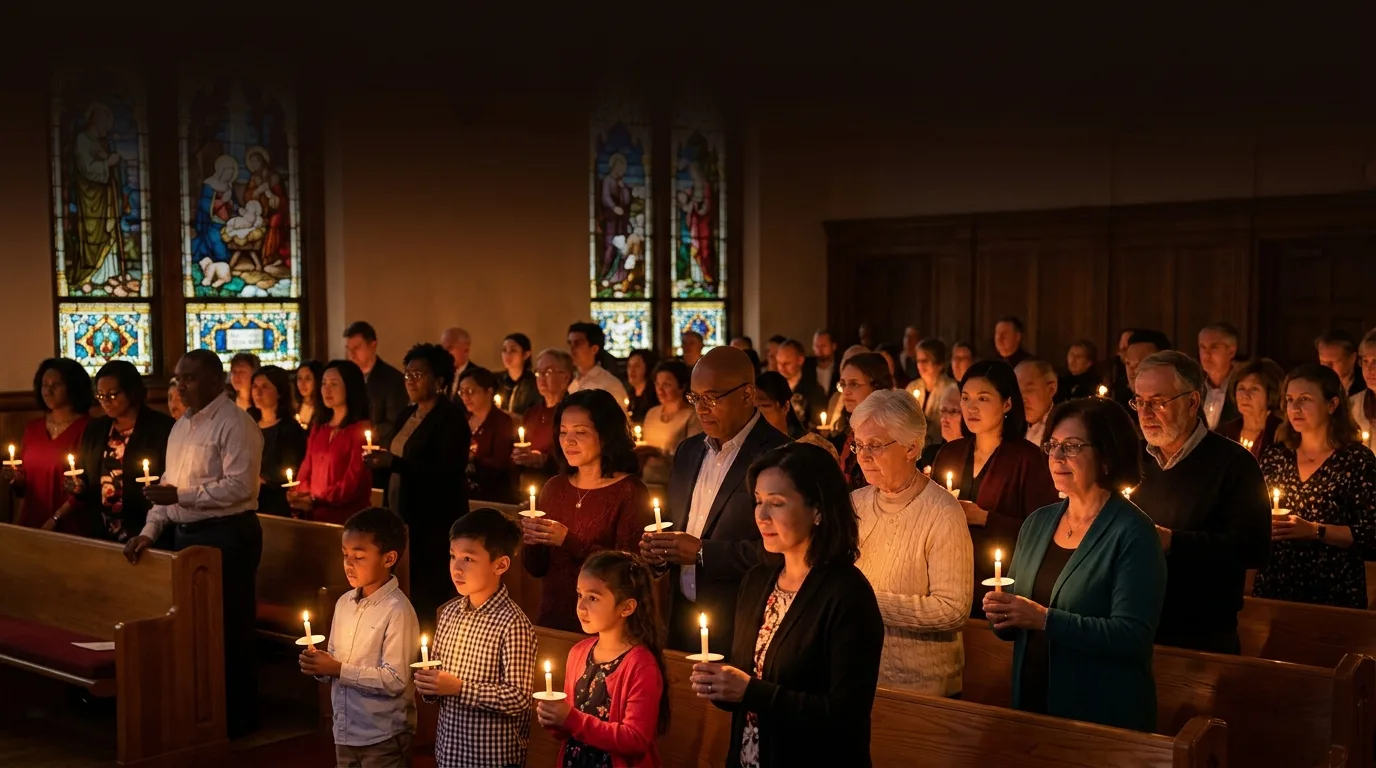
Christmas Eve is the one service of the year where the room is full of people who are not usually in it. Members who moved away and came home for the week. Adult children brought along by parents. People who stopped going to church somewhere that did not want them, and who are willing to try one more time because it is Christmas Eve and the building will be dark and nobody will ask them anything.
This is a complete candlelight order of worship for that room, free to print, project, adapt, and reprint. Written for progressive, affirming, and mainline congregations. No permission notice required, no attribution necessary.
Want to use all or part of the liturgy? We've made a PDF with the text available at no charge.
Christmas Eve 2026 falls on a Thursday. The Fourth Sunday of Advent is December 20, which gives you four days between the last Sunday of the season and the service itself — more breathing room than years when Advent 4 and Christmas Eve share a date, and worth using for a walkthrough with your candle lighters.
Christmas Day is Friday, December 25, and the First Sunday after Christmas falls on December 27. Congregations running an early family service and a later candlelight service can use this order for both; the notes below mark what to cut for the early one.
This liturgy runs about forty-five minutes with one homily, two scripture readings, and four hymns. It expands to a full Lessons and Carols shape, and it contracts to about twenty-five minutes for a family service. Both variations are marked in place.
Christmas Eve liturgies lean hard on light-and-darkness language, and Isaiah 9 invites it: the people who walked in darkness have seen a great light. Used carelessly, that pairing does theological work nobody intends — darkness as the enemy, light as the rescue, and a long shadow of racialized association behind both. Progressive congregations have been working away from it for years, and this liturgy assumes that work.
What it does instead is keep the night as a setting rather than a problem. The shepherds were working at night. The sky opened at night. In John the light shines in the darkness and the darkness does not overcome it — which is not the same as the darkness being defeated. The candles in this service are not fighting anything. They are company.
The second thing to know about this room: a meaningful share of it is grieving, estranged, newly single, newly out, or attending under duress. Christmas Eve is a high-attendance service and a high-loneliness one. The welcome below names that directly rather than assuming a congregation of the contented, and the sending does not require anyone to leave happy.
Practical notes
Decide your candle plan before the week of. Hand candles with drip protectors at the door, not mid-service. If your building or insurer does not allow open flame, LED tapers work and nobody minds; say so once at the welcome so it does not read as an oversight.
Light travels from a single flame outward. The Christ candle lights the ushers or deacons, who light the ends of the rows, and each person turns to the neighbor. Tell the congregation the rule once: the lit candle stays upright, the unlit candle tips into it. Wax on the coat is the only thing anyone remembers otherwise.
Dim the room in stages rather than at once. If the building has a dimmer, bring it down during the last scripture reading. If it does not, kill half the banks before the candlelighting and the rest after.
Assign someone to the people who cannot hold a candle — small children, anyone with limited grip, anyone sitting alone. A neighbor holding a second candle for someone is a better image than an empty hand.
If you livestream, put a camera on the room during the candlelighting rather than on the chancel. The wide shot is the whole point, and it is the clip that travels.
For a family or early service, cut the second scripture reading, the prayers of the people, and one hymn. Keep the candlelighting; it is the reason anyone came.
A word of welcome
Welcome. Whether you are here every week or have not been inside a church in years, you are in the right place tonight. This service does not ask you to believe anything in particular before it begins, and it will not ask you to perform anything you are not feeling.
Some of you came tonight out of habit, and some of you came out of longing, and some of you came because someone you love asked you to. All three are good reasons.
If you are carrying grief into this room, you are not the exception here. There was no room for this family either. Love was born in the space that was left over, which means there is no one here tonight who came to the wrong place.
One: The shepherds were working when it happened,
All: night laborers, the last ones anyone would think to tell.
One: The sky opened over the people at the edge of town,
All: and the news went to them first.
One: There was no room, so love was born in the space left over,
All: and has kept that habit ever since.
One: Tonight we are the people at the edge of town.
All: Tell us again.
One: Come, all of you, exactly as you arrived,
All: and let us worship. Amen.
Holy One, you did not arrive in the capital. You did not arrive in the temple. You arrived in a back room in an occupied province, to an unmarried teenager and a man who chose to stay, and the first people told were working a night shift in a field.
We have decorated this story until it is almost unrecognizable. Strip it back tonight. Let us hear what it actually says about where you go and who you go to. And let every person in this room hear it as news about themselves. Amen.
If your congregation has lit the Advent wreath through the season, this is the fifth lighting. The full Advent candle lighting liturgy is free and carries all five weeks.
One: Through four weeks we have lit hope, peace, joy, and love.
All: Tonight we light the candle at the center of them all.
One: The waiting is over.
All: The light has come, and it is staying.
The first four are the appointed readings for Christmas Eve, Proper I. They do not rotate with the lectionary year. References only — read from your congregation's preferred translation. Most services use Luke plus one other.
| Reading | Why it fits |
|---|---|
| Luke 2:1–14 (15–20) | The appointed gospel and the reason everyone came. Verses 15–20 give the shepherds somewhere to go; keep them if you can. |
| Isaiah 9:2–7 | The traditional first lesson. Read it for the government on his shoulders, not only for the light — it is a political text about a change of regime. |
| Psalm 96 | Appointed psalm. Works sung, or read responsively between two voices. |
| Titus 2:11–14 | Appointed epistle. Short, and rarely the strongest choice for this room; most congregations pass. |
| John 1:1–14 | Proper III, but frequently borrowed for the late service. The light shines in the darkness and the darkness does not overcome it. |
| Luke 1:46b–55 | The Magnificat. If you want the night to carry its politics, put Mary's song next to the census. |
| Micah 5:2–5a | One of the little clans. A quieter alternative to Isaiah 9 for congregations working away from light-and-dark framing. |
| Matthew 2:13–18 | The flight into Egypt. Rarely read on Christmas Eve and worth considering in a year when a congregation is close to the immigration story. Use with care. |
If your congregation reads the Magnificat tonight, read it without softening it. Mary is not describing a feeling. She is describing a reversal — the powerful pulled down, the hungry filled, the rich sent away empty — and she is describing it in the past tense, as something already done.
The traditional nine lessons run Genesis 3, Genesis 22, Isaiah 9, Isaiah 11, Luke 1:26–38, Luke 2:1–7, Luke 2:8–16, Matthew 2:1–12, and John 1:1–14, each followed by a carol. Seven lessons fits a Christmas Eve service better than nine; most congregations drop the two Genesis readings first.
That is not only a length decision. The first traditional lesson frames the whole sequence as a fall requiring repair, and the second is the binding of Isaac. Neither is the story most progressive congregations want to open Christmas Eve with, and neither is load-bearing for the arc. Genesis 1:1–5 or Isaiah 40:1–11 opens the same shape without the substitutionary frame: God speaks, light happens, a road gets made, and the story moves toward a birth.
Keep the carols between the lessons rather than after them. The sung response is what makes the form work.
Cut for a family or early service.
One: For everyone who is celebrating tonight, and everyone who is enduring it,
All: God who came to an ordinary family, be near.
One: For the first Christmas without someone, and the fortieth,
All: God who came to an ordinary family, be near.
One: For people spending tonight far from home, by choice and by force — the traveling, the deployed, the detained, the displaced,
All: God who was carried into Egypt, be near.
One: For everyone sitting in a family that does not know all of them yet,
All: God who chose the unlikely, be near.
One: For those working tonight so the rest of us can be here — the nurses, the drivers, the officers, the shepherds of this century,
All: God who told them first, be near.
One: For this congregation, and for the courage to be the room we say we are,
All: God with us, be near. Amen.
The center of the service. Do not rush it, and do not talk over it.
Introduction
In a moment the light is going to come down the rows. It starts at one flame and it does not get smaller by being shared. Tilt your unlit candle into your neighbor's lit one, and keep the lit one upright.
When you have light, turn and give it to the person beside you. If you came alone tonight, someone will turn to you. That is the whole design.
While the light passes
Silence, or an instrumental verse. Let it take as long as it takes — the room filling is the liturgy, not an interruption of it.
When the room is lit
One: Look up.
All: The light in this room came from one candle.
One: Nobody has less for having given it away.
All: Nobody here is holding the dark alone.
One: The Word became flesh and moved into the neighborhood,
All: and the light shines in the darkness, and the darkness has never put it out.
Sing here. "Silent Night" is in the public domain and needs no license; a specific modern arrangement may still be under copyright, so check the edition in your hymnal.
Blow the candle out, or don't yet. Either way, you are not leaving the light behind — it was never in the wax.
Go out into a night that is exactly as cold as it was when you came in, and tell someone. Start with whoever the rest of the world would think to tell last.
One: God with us,
All: not God waiting for us to be ready.
One: Go in peace. Christmas has already started.
All: Thanks be to God. Amen.
Check what is in your congregation's hymnal and licensed for your context. Titles only; PCM does not reproduce lyrics or sheet music.
Opening — O Come, All Ye Faithful · Once in Royal David's City · Angels We Have Heard on High
After the first lesson — O Little Town of Bethlehem · Comfort, Comfort Now My People · Lo, How a Rose E'er Blooming
After the gospel — Hark! The Herald Angels Sing · While Shepherds Watched Their Flocks · Go Tell It on the Mountain
Candlelighting — Silent Night · What Child Is This · In the Bleak Midwinter
Sending — Joy to the World · Go Tell It on the Mountain
For a congregation wanting expansive-language texts, several of these have widely used alternative versions in recent hymnals; check the edition you own before reprinting anything.
This liturgy is free and always will be. If you need the screens to match it, PCM's Advent and Christmas sets run from the wreath through Christmas Eve — dim enough for a candlelit room, and built so the last slide of Advent 4 and the first slide of Christmas Eve belong to each other.
Get everything with PCM Complete Browse the Christmas sets Write your own with LumenWhat is the order of worship for a Christmas Eve candlelight service?
A typical candlelight service runs gathering and welcome, call to worship, prayer of invocation, lighting of the Christ candle, scripture, homily, prayers of the people, the passing of the light with a carol, and a sending. The full order is on this page, free to adapt.
How long should a Christmas Eve service be?
Forty-five minutes to an hour for a main candlelight service with one homily, two readings, and four hymns. Twenty-five to thirty minutes for an early or family service. Lessons and Carols runs longer; seven lessons fits Christmas Eve better than nine.
What are the Christmas Eve lectionary readings?
Christmas Eve, Proper I, appoints Isaiah 9:2–7, Psalm 96, Titus 2:11–14, and Luke 2:1–14 (15–20). These do not rotate with the lectionary year, so they are the same every Christmas Eve.
When is Christmas Eve 2026?
Thursday, December 24, 2026. The Fourth Sunday of Advent falls on December 20, and the First Sunday after Christmas on December 27.
How does the candlelighting work?
The light starts at the Christ candle and passes outward, usually via ushers or deacons to the ends of the rows and then neighbor to neighbor. Tell the congregation once that the lit candle stays upright and the unlit candle tips into it.
Can we use LED candles instead?
Yes. Many buildings and insurers do not permit open flame, and LED tapers carry the same image. Say so once at the welcome so it does not read as an oversight.
What is Lessons and Carols?
A service form alternating scripture readings with carols, traditionally nine lessons running from Genesis to John 1. Most congregations use seven on Christmas Eve. The two Genesis lessons are the usual cuts, both for length and because the fall-and-repair framing is not where many progressive congregations want the night to start.
Can we reprint this liturgy in our bulletin?
Yes. Free to print, project, adapt, and include in recorded or livestreamed services. No license, no reporting, no per-use fee. Attribution to Progressive Church Media is appreciated where it fits and never required in worship.