No products in the cart.

Something shifts in a congregation when the sermon moves past comfort into conviction. You can feel it — a collective stillness, a held breath, the sense that the Word is not merely being explained but enacted. That is the moment when preaching becomes prophetic.
But what does "prophetic preaching" actually mean? The phrase circulates widely in progressive Christian spaces right now, especially as faith communities grapple with questions of justice, political power, and the moral witness of the church in troubled times. It can sound like a buzzword, or worse, a cover for partisanship dressed in clerical robes.
It is neither. Prophetic preaching is one of the oldest, most theologically grounded, and most distinctly Christian forms of proclamation. It predates the church itself. And for worship planners and pastors who feel called to speak into the suffering and injustice of their moment, understanding what prophetic preaching is — and what it is not — is essential preparation for the pulpit.
This guide offers that grounding: a theological account of prophetic preaching rooted in Scripture and tradition, an honest reckoning with its tensions, and practical starting points for integrating it into your congregation's worship life.
To understand prophetic preaching, you have to begin where it began: not in the op-ed pages of progressive Christianity, but in the covenant community of ancient Israel.
The Hebrew prophets — Amos, Isaiah, Jeremiah, Micah, Hosea — were not outside commentators lobbing criticism from a safe distance. They were insiders. They spoke within Israel, from within Israel's own covenant with God. Their authority derived not from political analysis but from a particular kind of divine appointment: they had been seized by the Word of God and compelled to speak it, regardless of the consequences.
What they spoke was consistently, urgently concerned with two things: fidelity to God and justice for the vulnerable. These were not separate concerns. For the Hebrew prophets, they were the same concern. The worship of a God who liberates slaves, who commands gleaning laws for the poor, who demands honest weights and measures, is inseparable from how that God's people treat the widow, the orphan, the stranger, and the laborer.
Amos thunders at Israel's worship assemblies: "I hate, I despise your festivals, and I take no delight in your solemn assemblies. Even though you offer me your burnt offerings and grain offerings, I will not accept them... But let justice roll down like waters, and righteousness like an ever-flowing stream" (Amos 5:21–24). This is not a rejection of worship. It is a demand that worship be coherent — that what happens inside the sanctuary align with how the congregation lives outside it.
Micah collapses the entire prophetic tradition into one of Scripture's most compressed and luminous sentences: "What does the Lord require of you but to do justice, and to love kindness, and to walk humbly with your God?" (Micah 6:8). Three verbs. Justice, kindness, humility before God. The prophetic tradition holds all three together and refuses to let any one of them absorb the others.
This is the river into which Christian prophetic preaching flows. It did not originate with progressivism. It originated with the God who said, "Let my people go."


Christian theology has traditionally described Jesus in terms of three offices: priest, prophet, and king. In progressive worship communities, the priestly office — Jesus as the one who mediates between God and humanity, who offers himself for the world — tends to receive the most attention. The royal office — Jesus as the coming reign of God made present — also gets significant theological airtime.
The prophetic office is often the quiet one.
This is a loss. Jesus understood himself as a prophet, and his earliest audience understood him as one too. When he stands in the synagogue at Nazareth and reads from the Isaiah scroll — "The Spirit of the Lord is upon me, because he has anointed me to bring good news to the poor... to proclaim release to the captives and recovery of sight to the blind, to let the oppressed go free, to proclaim the year of the Lord's favor" (Luke 4:18–19) — and then says, "Today this scripture has been fulfilled in your hearing," he is making an explicitly prophetic claim. Not merely a spiritual one. A claim about what God is doing in the world now, in this synagogue, in this body, in this moment of history.
Jesus's prophetic ministry had all the hallmarks of the Hebrew prophetic tradition: it was addressed to the covenant community from within, it held worship and justice together, it spoke comfort to the suffering and confrontation to those who benefited from unjust arrangements, and it cost him his life.
When Christian worship reclaims the prophetic office of Christ, it doesn't import foreign political categories into the sanctuary. It recovers something essential about who Jesus was and what his proclamation meant.
One of the most useful distinctions in the theology of prophecy is the difference between foretelling and forth-telling. Popular imagination tends to focus on foretelling — the prophet as predictor, the one who sees the future. But the vast majority of the biblical prophetic tradition is forth-telling: speaking the Word of God into the present moment with clarity, courage, and specificity.
Prophetic preaching is forth-telling. It is not primarily about prediction. It is about perception — seeing the world as God sees it, and naming what is seen, even when the naming is unwelcome.
That distinction matters enormously for what prophetic preaching is not.
Prophetic preaching is not partisan political commentary. A prophetic sermon does not endorse candidates, align with party platforms, or function as a political rally with liturgical framing. Its authority derives from Scripture and theological tradition, not from ideological affiliation. The test of prophetic preaching is whether it could have been preached by Amos, Isaiah, or Jesus — not whether it would fit on a bumper sticker.
Prophetic preaching is not the pastor's personal platform. The prophetic tradition has always involved a strange grammar of divine compulsion: "The Lord said to me..." The prophetic preacher speaks not from personal conviction alone but from a sense of being addressed by the Word and accountable to the community. Prophetic preaching requires deep listening before it involves bold speaking.
Prophetic preaching is not simply preaching on social issues. A sermon about immigration policy that stays at the level of policy analysis is not prophetic preaching — it is current events commentary with a scriptural citation bolted on. Prophetic preaching moves through the particular to the theological: it asks what the situation reveals about God, about the human condition, about the covenant community's faithfulness or faithlessness, about the direction of history as Scripture understands it.
Prophetic preaching is not angry. The prophets are sometimes portrayed as fierce and furious, and their words can be — but the dominant emotional register of the prophetic tradition is grief. Jeremiah weeps. Hosea aches. Jesus weeps over Jerusalem. The prophetic preacher speaks hard truth from a place of love for the congregation and sorrow at what is broken, not from contempt for anyone inside or outside the room.
What prophetic preaching is, at its core, is this: the proclamation of God's vision for justice, wholeness, and right relationship — shalom — and the naming of whatever falls short of that vision, addressed to the covenant community, grounded in Scripture, and offered in the service of transformation rather than condemnation.
One of the most common objections progressive pastors encounter is some version of: "Keep politics out of church." The objection is worth taking seriously, not dismissing. It often comes from genuine concern about the integrity of worship and the unity of congregations across difference.
But the theological response is important: worship has never been politically neutral, and the assumption that it can or should be is itself a theological position — and a relatively recent one in the long history of the church.
The Calvin Institute of Christian Worship describes worship planners as called to a task that is simultaneously priestly and prophetic. The selection of which Scripture texts will be read, which themes will be emphasized, which voices will be heard, which aspects of the human situation will be named before God and which will remain unspoken — all of these are acts of interpretation that carry enormous theological and social weight. There is no neutral worship service. The question is not whether your worship makes claims about the world, but whether it does so consciously and faithfully.
Moreover, the Hebrew prophets consistently located their proclamation inside worship settings. Amos delivers his oracle in the context of Israel's temple worship. Isaiah receives his call inside the temple, in the year King Uzziah died. Jesus delivers his prophetic manifesto in the synagogue, reading from the scroll of Isaiah. The prophetic word has always been addressed to the worshiping community — because the worshiping community is the community most responsible for embodying God's justice in the world.
There is also a liturgical logic to prophetic preaching that worship planners are especially positioned to understand. The basic shape of Christian worship — gathering, Word, table, sending — is itself a prophetic arc. We are gathered as a people called out of ordinary life. We hear the Word that reframes reality according to God's purposes. We are nourished at a table where all are equally welcome and equally fed. And we are sent back into the world to live what we have received. Prophetic preaching doesn't disrupt that arc. It fulfills it.
Here is the tension that most honest worship planners and pastors will name: the congregation sitting in those pews is not a monolith. It contains people who are suffering unjust systems and people who benefit from them, sometimes without knowing it. It contains people who are ready to be challenged and people who are barely holding on. It contains people who need confrontation and people who desperately need comfort.
The temptation is to resolve this tension by choosing one role — pastoral or prophetic — and staying safely in it. But the biblical tradition refuses that choice. The prophets are not merely confronters; they are also comforters. Isaiah 40 opens with "Comfort, O comfort my people, says your God" — and then proceeds to one of Scripture's most expansive visions of justice and restoration. Jeremiah weeps and rages. Jesus heals and overturns tables. The pastoral and the prophetic are not opposites. They are held together in the one who is simultaneously the Good Shepherd and the one who drives the money changers from the temple.
Scholars at the intersection of homiletics and pastoral theology have argued persuasively that prophetic preaching, rightly understood, is pastoral care — care for the whole person and the whole community, including the ways unjust arrangements damage both those they harm and those they privilege. The goal is not to polarize the congregation but to invite it, together, to see what God sees and move in the direction God is moving. That is a pastoral act, even when it is uncomfortable.
In practice, this means several things for the prophetic-pastoral preacher:
Know your congregation's story. Prophetic preaching that doesn't know the history, wounds, and specific context of the people it addresses will land wrong, however theologically sound it is. The prophets always knew the people to whom they spoke.
Preach to the community, not against it. The prophetic preacher stands with the congregation before the Word, not above the congregation in judgment. "We" is usually more prophetically honest than "you."
Hold lament and hope together. The prophetic tradition never ends in despair. Even Jeremiah, writing from the ruins of Jerusalem, speaks of a future with hope (Jeremiah 29:11). Prophetic preaching names what is broken and then points toward the God who is not finished.
Be patient with different timelines. Not every member of your congregation is in the same place of awareness or readiness. Prophetic preaching is not a single sermon but a sustained practice, a long pastoral relationship between a community and the Word.
For worship planners, the question eventually becomes concrete: Where do we begin?
The good news is that the Revised Common Lectionary — the three-year cycle of Scripture readings used by most mainline Protestant and many other churches — is full of prophetic texts waiting to be preached prophetically. The challenge is not finding the material; it is developing the homiletical and liturgical framework to handle it faithfully.
Start with the Hebrew prophets. The lectionary regularly surfaces texts from Amos, Isaiah, Micah, and Jeremiah. When those texts appear, resist the urge to spiritualize them. Amos's critique of economic exploitation is a critique of economic exploitation. Let it be that. Then ask what that specific critique illumines about your congregation's context, and what faithful response might look like.
Use the full shape of the liturgy prophetically. The Call to Worship can frame the gathering as a people called to justice. The Prayer of Confession can name specific ways the congregation — corporate, not just individual — has fallen short of God's vision for the world. The Prayers of the People can name suffering that is not abstract. The Sending can commission rather than merely dismiss. You don't have to wait for the sermon to preach prophetically.
Preach series, not single sermons. A single prophetic sermon can feel like an ambush. A sustained series — on the Hebrew prophets, on the Sermon on the Mount, on Luke's Gospel, on the book of Amos — builds theological vocabulary over time and invites the congregation into a shared journey rather than a confrontation.
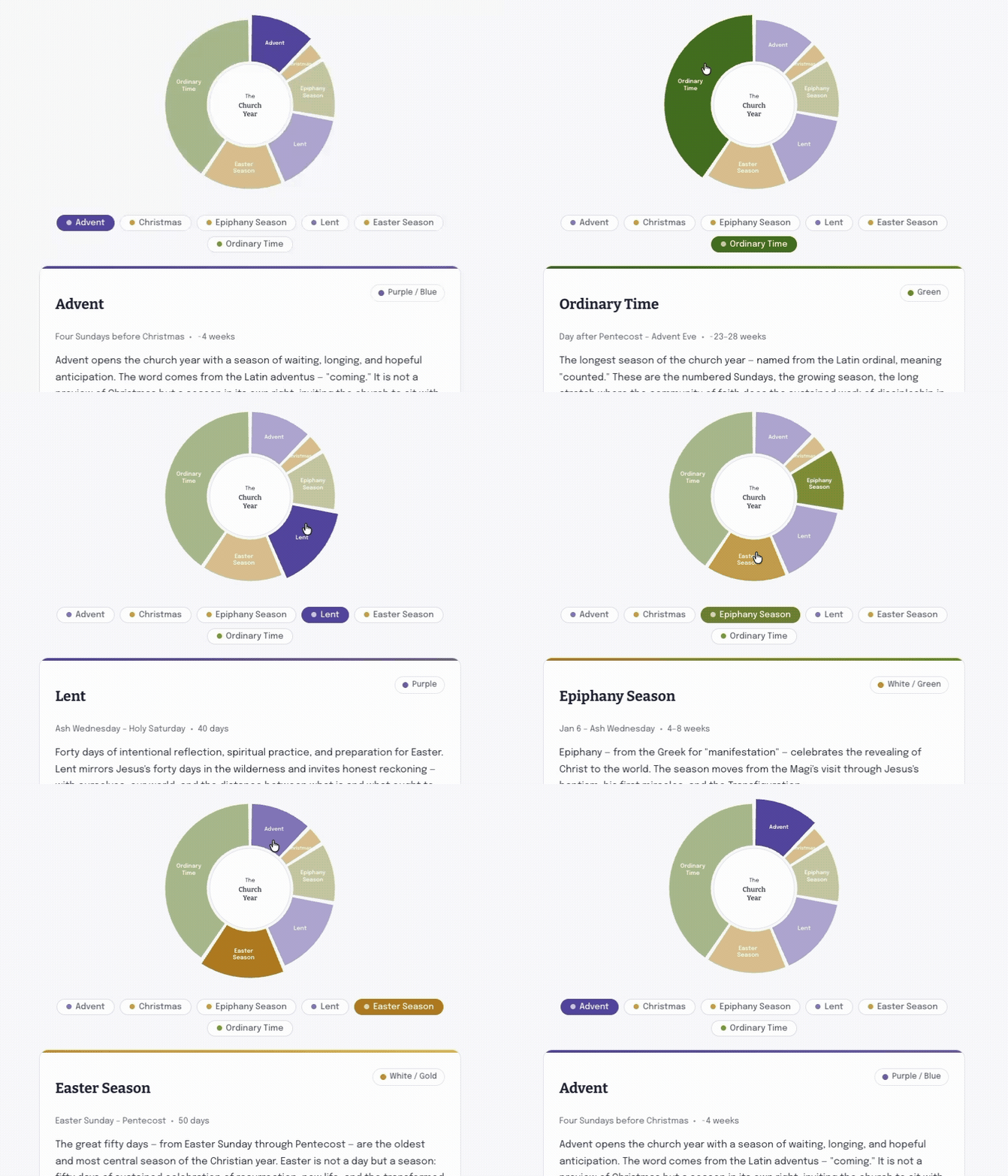
Anchor to the liturgical calendar. Ordinary Time — the long season of the church year that runs from Pentecost to Advent — is the season of engaged witness in the world. It is the season when the resurrection community lives out what it has received. Juneteenth, Pride Month, Labor Day, Indigenous Peoples' Day, and World Communion Sunday all fall within Ordinary Time. The season itself is a prophetic invitation to connect worship and world.
Cite your theological sources. Prophetic preaching gains credibility when it demonstrates its rootedness in the tradition. Walter Brueggemann's The Prophetic Imagination remains the essential text for this conversation — readable, theologically rigorous, and deeply pastoral. Cornel West, Emilie Townes, Raphael Warnock, and Ada María Isasi-Díaz offer voices from the liberation theology tradition that have shaped progressive Christian prophetic practice. Naming these sources in sermons and worship resources helps congregations understand that what they are receiving is not personal opinion but a rich and ancient stream of Christian witness.
Leave room for response. Prophetic preaching that only confronts, without creating space for response, can leave congregations feeling accused but not accompanied. Consider building in moments of corporate lament, reflection, or commitment — a litany, a time of silence, a congregational prayer of response — that invite the community to do something with what it has heard.

Walter Brueggemann, The Prophetic Imagination (Fortress Press) — The essential starting point. Brueggemann traces the prophetic imagination from Moses through the Hebrew prophets through Jesus, arguing that prophetic ministry involves both the critique of dominant consciousness and the energizing of the community with an alternative vision.
Raphael Warnock, The Divided Mind of the Black Church (NYU Press) — A rigorous theological and historical account of how the Black church has navigated the tension between pietism and prophetic social engagement, with implications for all Christian traditions wrestling with the same question.
Emilie M. Townes, Womanist Ethics and the Cultural Production of Evil (Palgrave Macmillan) — Essential womanist theological perspective on how injustice is perpetuated and what faithful, embodied resistance looks like.
Calvin Institute of Christian Worship — An indispensable resource for worship planners seeking theologically grounded guidance on integrating justice into the full shape of the liturgy.
United Methodist Discipleship Ministries, Bridging Visions 2: Prophetic Voices, Pastoral Hearts — A recent resource that addresses the pastoral-prophetic tension directly, with practical guidance for worship leaders.
NC Council of Churches, Acts of Faith Lectionary Resources — Free lectionary-based resources that integrate justice themes with specific Scripture texts throughout the liturgical year.
For additional worship planning support, including resources for Ordinary Time, Juneteenth, Pride Month, and other seasons of engaged witness, explore our full library.