No products in the cart.
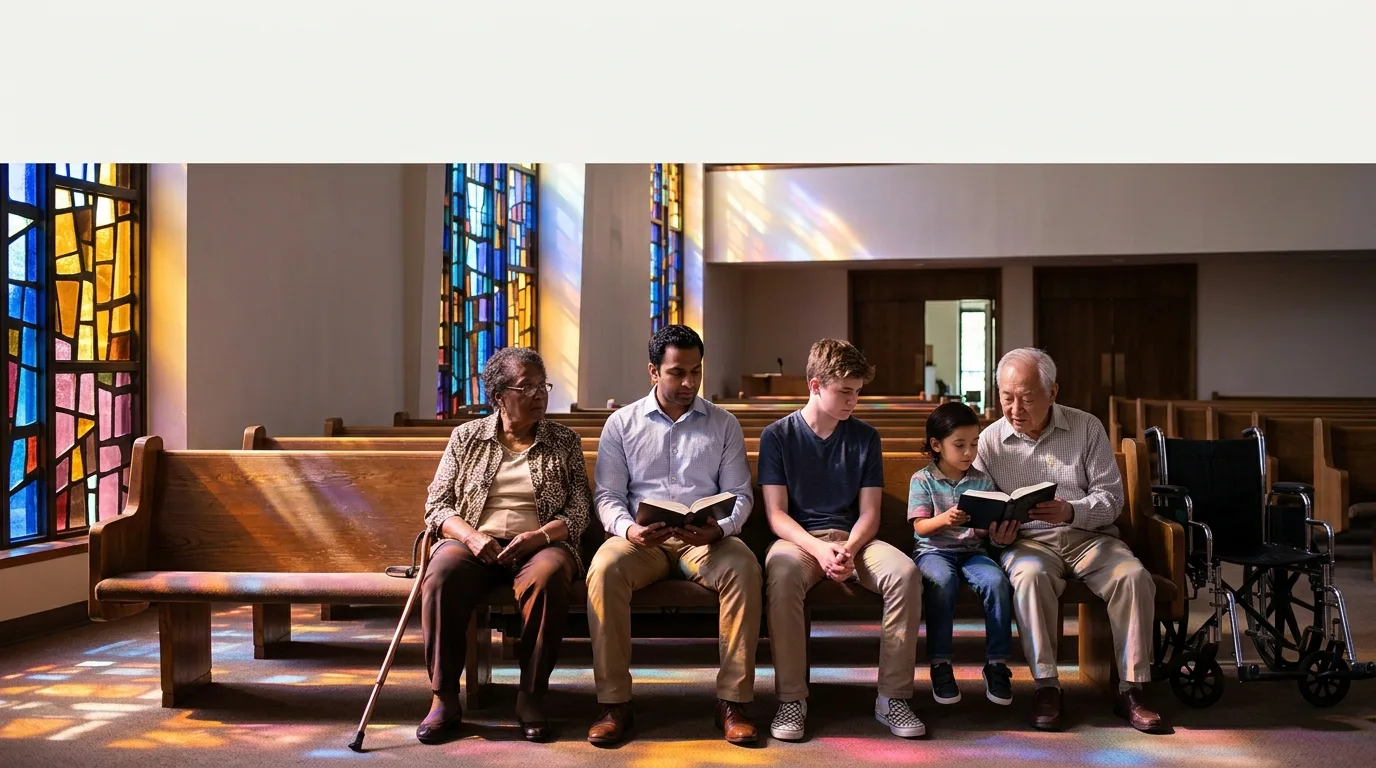
This article is written for that Sunday. It does not soften the numbers, because you have already seen them with your own eyes and you would not trust anyone who pretended otherwise. But it also refuses the story the church-growth industry has been selling for two decades — the one where the people who have kept your congregation alive for forty years are recast as the obstacle.
They are not the obstacle. They are the reason there is still a church there to worry about.
The numbers, plainly
Sources: Pew Research Center, 2023–24 Religious Landscape Study · National Congregations Study, 2018–19, via the Lewis Center for Church Leadership · PRRI, Religious Change in America · Hartford Institute for Religion Research, Faith Communities Today 2025 (released April 2026).
This is not a feeling. It is one of the most consistently measured facts in American religion.
The National Congregations Study puts a number on how quickly the ground moved. In the average U.S. congregation, the share of adults over 60 rose from 29% in 1998 to 43% in 2018–19. Over the same twenty years, the share under 35 fell from 30% to 24%.
Broken out by tradition, the gap is stark: in 2018–19, 57% of mainline Protestant participants were over 60, compared with 51% of Roman Catholics, 39% of Black Protestants, and 32% of evangelical Protestants.
And Faith Communities Today found that 33% of congregational participants were 65 or older, against 17% of the general population. Your congregation is not imagining that it skews older than the town it sits in. It does — by roughly double.
Now the part that did not make it into the doom coverage.
In April 2026, the Hartford Institute for Religion Research released its Faith Communities Today survey of 7,453 congregations. Median in-person worship attendance rose from 65 in 2020 to 70 in 2025 — the first positive gain in median attendance in twenty-five years. Forty-three percent of congregations reported growing by at least 5%. Congregational income climbed. Volunteering is up. Fewer clergy report thinking about leaving ministry.
The researchers were careful, and so should we be: this is not revival, and it does not reverse decades of decline. The median mainline congregation still reported 50 worshippers, and mainline churches were more likely than others to report deficits. Hartford's co-director called the finding "cautious optimism" and described it as resilience and recalibration rather than return.
Pew's own conclusion runs parallel: the decline of Christianity in the U.S. has slowed and may have leveled off.
So the honest summary is this. Your congregation is older than the country around it, and that is a real constraint with real consequences for volunteers, budgets, and pastoral load. And at the same time, for the first time in a quarter century, the trend line under all congregations stopped falling. Both things are true. Plan for both.
Three forces, stacked.
First, everyone's participation dropped, but younger generations dropped further. Each cohort since the 1960s has participated in religious life at lower rates than the one before it did at the same age. This is not a mainline problem; it is an American one.
Second, mainline churches did not hold their young adults through the late twentieth century, and a denomination that loses a generation does not feel it for thirty years — and then feels it all at once, in the pledge drive and the nominating committee.
Third — and this is the one the most church-growth blogs will not write — a very large share of the people who left cite the church's treatment of LGBTQ+ people as a reason. PRRI found that 47% of religiously unaffiliated Americans name their childhood religion's teachings about LGBTQ+ people as a reason they no longer identify with it, up from 29% in 2016. Among those under 30, it is 60%.
Sit with the position that puts an affirming congregation in. Your church may have been ordaining queer clergy and blessing same-sex marriages for years. It absorbed real cost to do it — members left, budgets shrank, some of you lost friendships. And you are still losing young adults to a reputation earned by churches that made the opposite choice, because from the outside "church" is one word.
That is genuinely unfair. It is also, strategically, the most useful fact in this article — because it tells you exactly what the work is. The work is not becoming more welcoming. You already are. The work is becoming legible.
One more piece of realism before the hopeful part. PRRI also found that only about 9% of religiously unaffiliated Americans say they are looking for a religious home. So a campaign built on the assumption that there is a large market of young people shopping for a church will underperform, no matter how good the postcard is. The people who will find you are the ones who are already looking — often quietly, often carrying an old wound, often at 11 p.m. on a phone. Being findable and unmistakable for them beats broadcasting to everyone else.
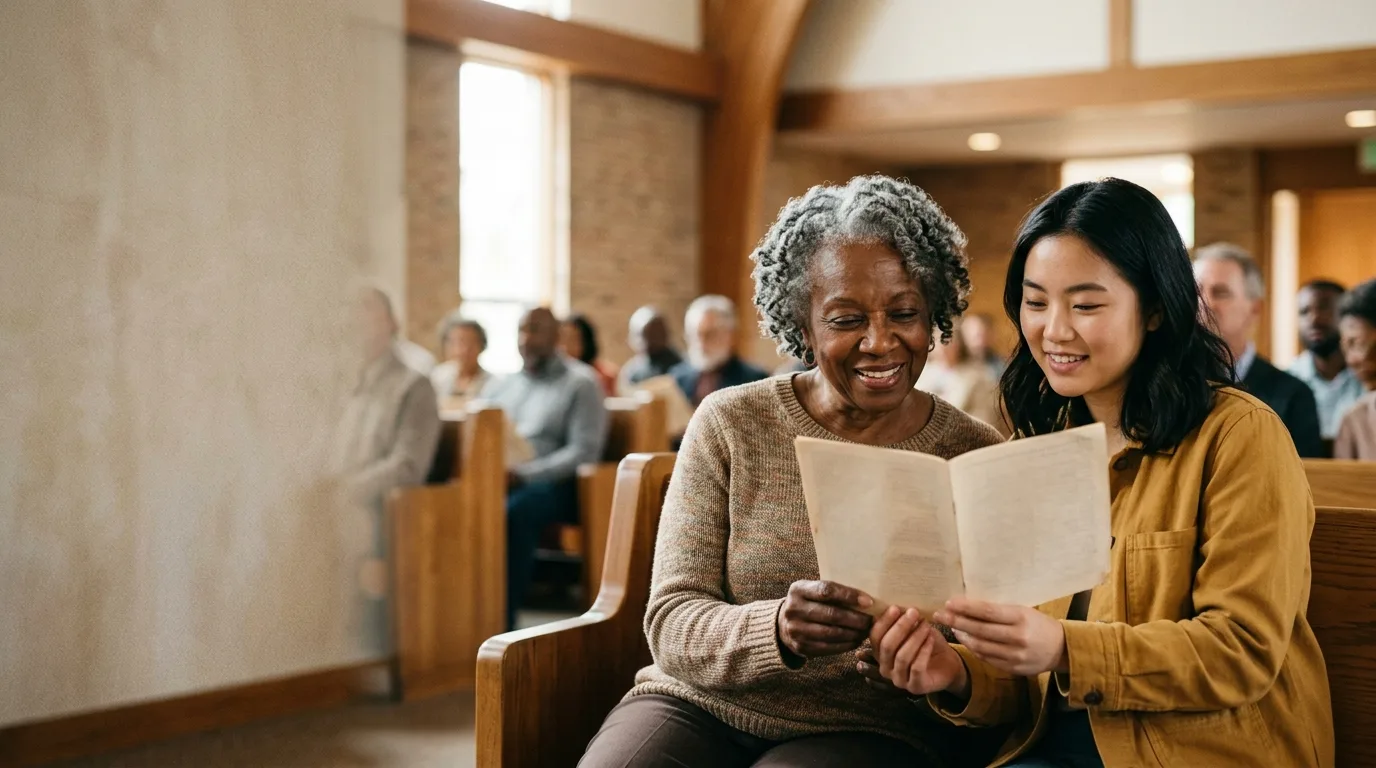
Most articles on this topic reaches this point and pivots to "how to get younger." We are going to spend a section here first, because congregations that skip it end up doing the second half badly. Young adults can tell instantly whether a church loves the people already in it. If a congregation treats its eighty-year-olds as dead weight, no visitor believes they will be treated well at thirty.
Specificity is the whole thing. "We appreciate our seniors" is wallpaper. Naming is worship.
For a congregation that has buried people it loved, a name-reading tacked onto announcements is not enough. Backgrounds, slides, and social graphics for a service that grieves honestly and honors the saints your congregation actually knew.
Browse All Saints resourcesAging bodies are not a hospitality problem to be managed. They are the ordinary condition of a long-lived congregation, and worship that assumes otherwise quietly disinvites people who very much want to be there.
Every slide set in PCM Complete is built for real sanctuaries and real eyes — high-contrast type, generous sizing, clean backgrounds that text survives on top of. Unlimited downloads, new seasonal sets year-round, and imagery that shows congregations at every age. Made for progressive, affirming, and mainline churches, in English and Spanish.
Join PCM CompleteAnnual membership. Everything you download stays yours.
The reflex in a shrinking congregation is to move older members into ceremonial roles and hand the working roles to the few younger people, which manages to insult both groups at once. Older adults are not retired from discipleship. Many of them have more discretionary time, more accumulated skill, and more institutional courage than anyone else in the building.
Not recipients. Practitioners. This is where progressive congregations have a structural advantage, because justice work runs on exactly what older members have most of: time, persistence, credibility, and a very low fear of being embarrassed in public.
Now the second half. Note what is not on this list: a drum kit, a fog machine, or a "contemporary service" that splits your congregation into two smaller congregations that never meet.
Given what PRRI found about why young people leave, this is the highest-leverage change most affirming churches can make, and it costs nothing.
Most churches silo by age — seniors Tuesday, youth Wednesday, young families Thursday — and then wonder why the generations do not know each other. The congregations that hold young adults tend to do the opposite.
Keep children in the sanctuary for the whole service some Sundays and let it be loud. Put a nineteen-year-old and a seventy-nine-year-old on the same committee with the same vote. Serve one coffee hour, not two. If you have two services, make sure it is not functionally an age filter.
Almost everyone visits your website before they visit your building, most of them on a phone, and many of them on a Saturday night. A younger visitor deciding whether to walk in wants four things findable in under thirty seconds: what time is worship, where do I park, what do people wear, and will I be safe here. If your site cannot answer those on a phone screen without pinching to zoom, it is turning people away before your greeters ever get a chance.
Livestream still matters, and not only for people who are homebound. It is how a cautious visitor watches you three times before risking a Sunday.
Young adults do not leave churches because the music was wrong. They leave because they were asked to do the work and never given the authority. Put someone under thirty-five on the budget committee. Let a young adult redesign something and then actually ship their version, including the parts you would have done differently. A twenty-eight-year-old who has genuine decision-making power tells their friends. A twenty-eight-year-old who has been on the "young adult task force" for two years tells their friends something else.
Doubt. Money. Mental health. Climate grief. Deconstruction. Sexuality. Caring for aging parents while raising children. The younger people who are still open to church are not looking for easy answers — they are looking for a community honest enough to admit the questions are hard and stay in the room anyway.
That is, as it happens, exactly what progressive theology is built to do. It is your best asset and it is almost never on your homepage.
Stock photography is why so many church slides show a congregation nobody actually has. PCM Imago generates worship images from inclusive, affirming presets — a real range of ages, races, abilities, and family shapes, without a design program. PCM Lumen drafts the liturgy for an intergenerational service while you are still deciding on the hymns.
Try PCM Imago freeImago creates still images. For motion backgrounds and loops, see the shop.
The church-growth literature treats age as a problem. Scripture does not.
When Peter preaches at Pentecost, he reaches for Joel: "your old shall dream dreams, and your young shall see visions" (Acts 2:17, quoting Joel 2:28, NRSVue rendering). The dreaming is assigned to the old. It is not consolation offered to people whose useful years are behind them — it is a job, given in the same breath as the young people's visions, in a text about the Spirit poured out on everyone without distinction.
The psalmist is more direct: "In old age they still produce fruit; they are always green and full of sap" (Psalm 92:14, NRSVue).
And when Luke needs witnesses to say who Jesus is, he does not summon a crowd of young disciples. He gives us Simeon, and Anna — a widowed prophet of eighty-four who had not left the temple in decades, and who is the first person in that Gospel to go tell everyone (Luke 2:36–38).
A congregation whose median age is sixty-two is not a congregation in its last chapter. It is a congregation full of people scripture assigns the dreaming to. Preach that in September and watch what happens in the fall pledge campaign.
Here is where the numbers actually leave you.
Your congregation is older than the community around it, and that is real. The trend that produced it took sixty years and will not reverse in one program year. Anyone promising otherwise is selling something.
And: attendance across American congregations rose in 2025 for the first time in twenty-five years. The long slide in Christian affiliation appears to have leveled off. Nearly half of congregations grew. The specific thing young people say drove them away is the specific thing your church has already refused to do — you just have not said so loudly enough, or in the words they are searching with.
The most faithful thing most aging congregations can do is not to chase youth. It is to become so unmistakably, publicly, joyfully itself that the people looking for exactly this can finally find it. Honor the people who kept the lights on. Make the building work for the bodies in it. Say the affirming part first and out loud. Hand real power to whoever shows up ready to carry it, at any age.
The old will dream dreams. That was always the plan.
What is the average age of church members in mainline denominations? Mainline Protestants are the oldest major religious group in the United States. Pew Research Center's 2023–24 Religious Landscape Study found that 64% of mainline Protestants are 50 or older, compared with 57% of Catholics and 54% of evangelical Protestants. The median age of U.S. Christians overall rose from 46 in 2007 to 54 in 2024, while the median age of religiously unaffiliated adults held steady at 38. In earlier Pew data, PC(USA) and United Church of Christ members showed a median age of 59.
Are all churches shrinking, or just mainline ones? Not anymore, and this is the most encouraging finding in years. The Hartford Institute for Religion Research's 2025 Faith Communities Today survey of 7,453 congregations, released in April 2026, found median in-person worship attendance rose from 65 in 2020 to 70 in 2025 — the first gain in median attendance in twenty-five years. Forty-three percent of congregations grew by at least 5%. Researchers were clear this is stabilization rather than revival, and the median mainline congregation still reported 50 worshippers, but the trend line stopped falling.
Why are young people leaving churches? The reasons are layered. Every generation since the 1960s has participated at lower rates than the one before it. But PRRI found that 47% of religiously unaffiliated Americans cite their childhood religion's teachings about LGBTQ+ people as a reason they left — 60% among those under 30, up from 29% overall in 2016. For affirming congregations, this is a painful irony: they are carrying the reputational cost of decisions other churches made.
How can an aging congregation attract younger members without alienating older ones? By refusing the premise that those are opposing goals. Congregations that hold young adults are usually the ones visibly good to their oldest members, because a visitor reads how a church treats its eighty-year-olds as a preview of how it will treat them. The practical moves are intergenerational rather than segregated: shared committees with real votes for people at both ends of the age range, one coffee hour instead of two, children in the sanctuary, and worship that is physically accessible to everyone present.
What is the single most effective change an affirming church can make? Making its affirmation unmistakable within the first ten seconds on its website, in the words a searcher actually types. Many progressive congregations have been fully affirming for years but bury it on an inner page in denominational language. Someone hurt by a church searches for "affirming church near me," not "Open and Affirming congregation." Using plain, specific language above the fold — and showing it in photographs of the actual congregation — costs nothing and addresses the top stated reason young people leave.
Is it worth investing in worship technology for an older congregation? Yes, but for reasons that are often misunderstood. The highest-return technology investments in an aging congregation are accessibility investments: larger, higher-contrast projection type, assistive listening that is tested regularly, captioned livestream, and images that represent the people actually in the room. These serve older members immediately, and they happen to be exactly what younger visitors evaluate a church by. Screens and streams are not a concession to youth culture; they are how a congregation stays reachable at every age.