No products in the cart.
This guide is part of our complete guide to the Halloween, Día de los Muertos, and All Saints season
For a progressive, affirming congregation, this is a day of memory and hope: a chance to name our dead aloud, to give thanks, and to proclaim that love holds us together across the boundary of death. This is a guide to observing All Saints' and All Souls' with depth, beauty, and welcome.
All Saints' Day falls on November 1, with All Souls' Day following on November 2. Together with All Hallows' Eve (October 31), they make up the season the church has long called Allhallowtide — three days devoted to remembering the dead and the great cloud of witnesses who came before us.
Historically, the two days carried a subtle distinction: All Saints' honored the recognized saints of the church, while All Souls' remembered all the faithful departed. In practice, many Protestant and progressive congregations hold the two together, observing a single All Saints' or All Saints' Sunday that remembers everyone — the canonized and the uncanonized, the renowned and the deeply ordinary. It's one of the principal feasts in the Anglican, Lutheran, Methodist, and Reformed traditions, and it's marked across the UCC, the Episcopal Church, the ELCA, the UMC, and the PCUSA.
At the heart of All Saints' is a phrase from the ancient creeds — the communion of saints. It names a conviction that runs to the center of Christian hope: that the church is not only the people gathered in the room today, but a vast and unbroken fellowship reaching back through every generation and forward beyond death. The people we have loved and lost are not severed from us. They remain part of the body, part of the great company that surrounds and sustains us.
For progressive Christians, this doctrine carries a particular grace. It widens the circle of "the saints" far beyond an official list to include everyone whose love and witness shaped us — the grandmother whose faith was quieter than any sermon, the friend who showed us how to be brave, the activists and ancestors who bent the world toward justice. To remember them on this day is to insist that their lives still matter, and that we are who we are because of them.
All Saints' invites worship that is both tender and hopeful. A few of the practices congregations find most meaningful:
The necrology is the reading of names — those in the congregation who have died in the past year, and often the names that members carry in their own hearts. Read slowly, with a candle lit or a bell tolled for each name, it becomes the emotional center of the service. Invite the congregation in advance to submit names, and leave space for people to speak aloud the names of their own beloved dead.
Free: our complete All Saints Day liturgy, including the reading of the names →
Use our All Saints remembrance slides →
A table of candles that members can come forward to light — for a parent, a child, a friend, a mentor — turns remembrance into something the whole body does together. Paired with quiet music, it gives grief a place to be held in community rather than alone.
Hymns carry this day. "For All the Saints," "Sing with All the Saints in Glory," and "I Sing a Song of the Saints of God" have anchored All Saints' worship for generations, and progressive congregations often pair them with newer texts that widen the vision of who the saints are.
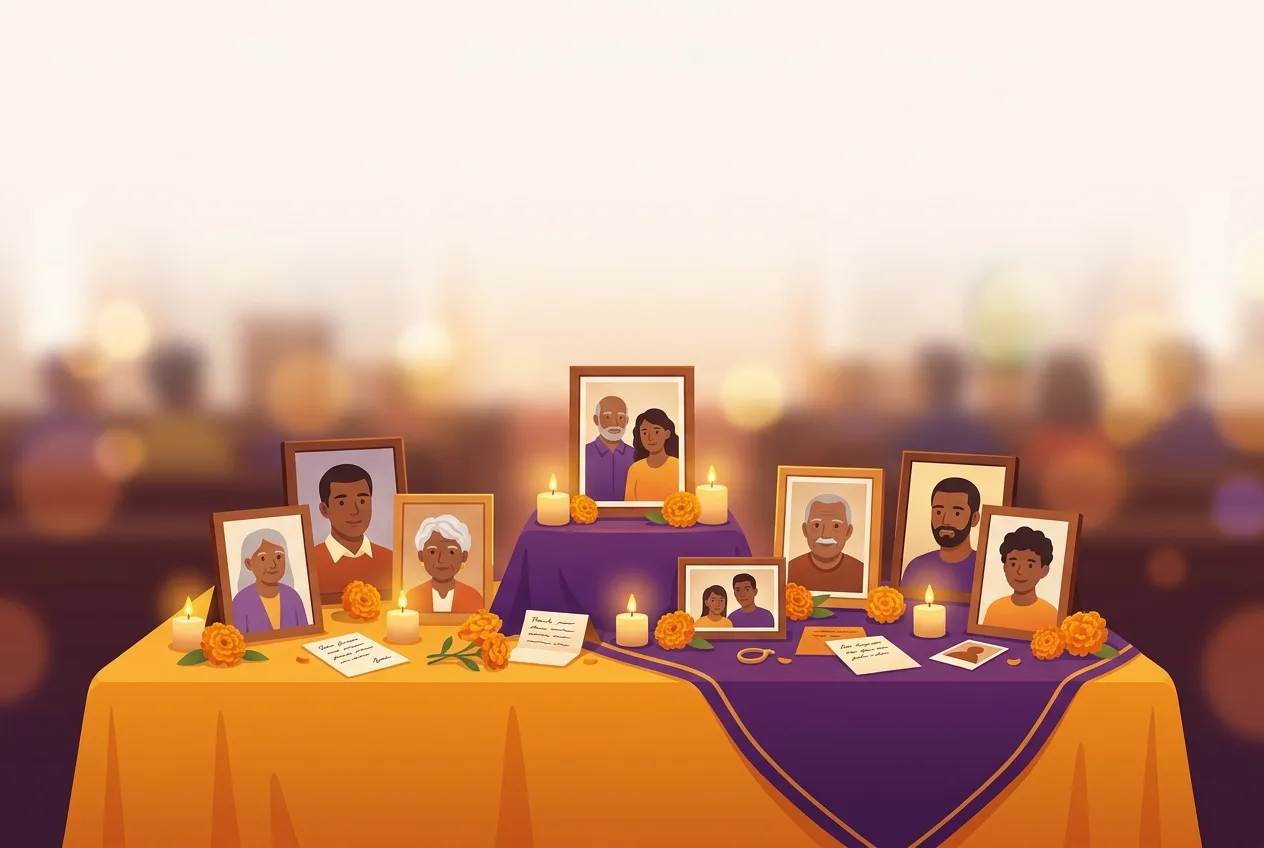
Borrowing from Día de los Muertos, some churches build a communal altar or memory table where members bring photographs of those they wish to remember. It gives the day a visual and physical center, and it welcomes the traditions of Latino and bilingual members into the whole congregation's worship.
All Saints' Day doesn't stand alone — it's the destination of a connected season. The very word "Halloween" is a worn-down form of "All Hallows' Eve," the night before this feast. And Día de los Muertos, observed on November 1 and 2, carries the same remembrance of the beloved dead in Indigenous and Latino tradition.
Held together, these days tell one story: a welcoming Halloween gathering opens the door to the neighborhood, Día de los Muertos honors the dead with color and joy, and All Saints' gathers it all into worship and the communion of saints. Many congregations let the threads connect — a trunk-or-treat one evening, a remembrance service the next — so the season moves naturally from hospitality to memory to hope.
Whether you're planning a single All Saints' Sunday or observing the full Allhallowtide season, the right visuals help carry its tenderness and hope. Explore the full season in our guide to Halloween, Día de los Muertos, and All Saints for progressive churches, and find bilingual worship media — including Día de los Muertos graphics, slides, and video well suited to a communal memory table — alongside the Worship in Spanish collection. For the welcoming events that open the season, see our church Halloween ideas.
When is All Saints' Day?
All Saints' Day is November 1, and All Souls' Day is November 2. Many congregations observe All Saints' Sunday on the first Sunday in November when the dates fall on a weekday.
What is the difference between All Saints' Day and All Souls' Day?
Historically, All Saints' Day (November 1) honored the recognized saints of the church, while All Souls' Day (November 2) remembered all the faithful departed. Many Protestant and progressive churches hold the two together in a single service remembering all who have died.
What is the communion of saints?
The communion of saints is the belief that the church is one unbroken fellowship of the faithful across all time — the living and the dead together. It expresses the conviction that those we have loved and lost remain part of the body of Christ and are not separated from us.
How is All Saints' Day related to Halloween?
"Halloween" comes from "All Hallows' Eve," the evening before All Saints' Day. Together with All Souls' Day, the three days form the season of Allhallowtide, all centered on remembering the dead and the communion of saints.
Can progressive and Protestant churches celebrate All Saints' Day?
Yes. All Saints' Day is a principal feast in the Anglican, Lutheran, Methodist, and Reformed traditions and is widely observed across the UCC, Episcopal Church, ELCA, UMC, and PCUSA, often with an inclusive emphasis on remembering all the beloved dead.