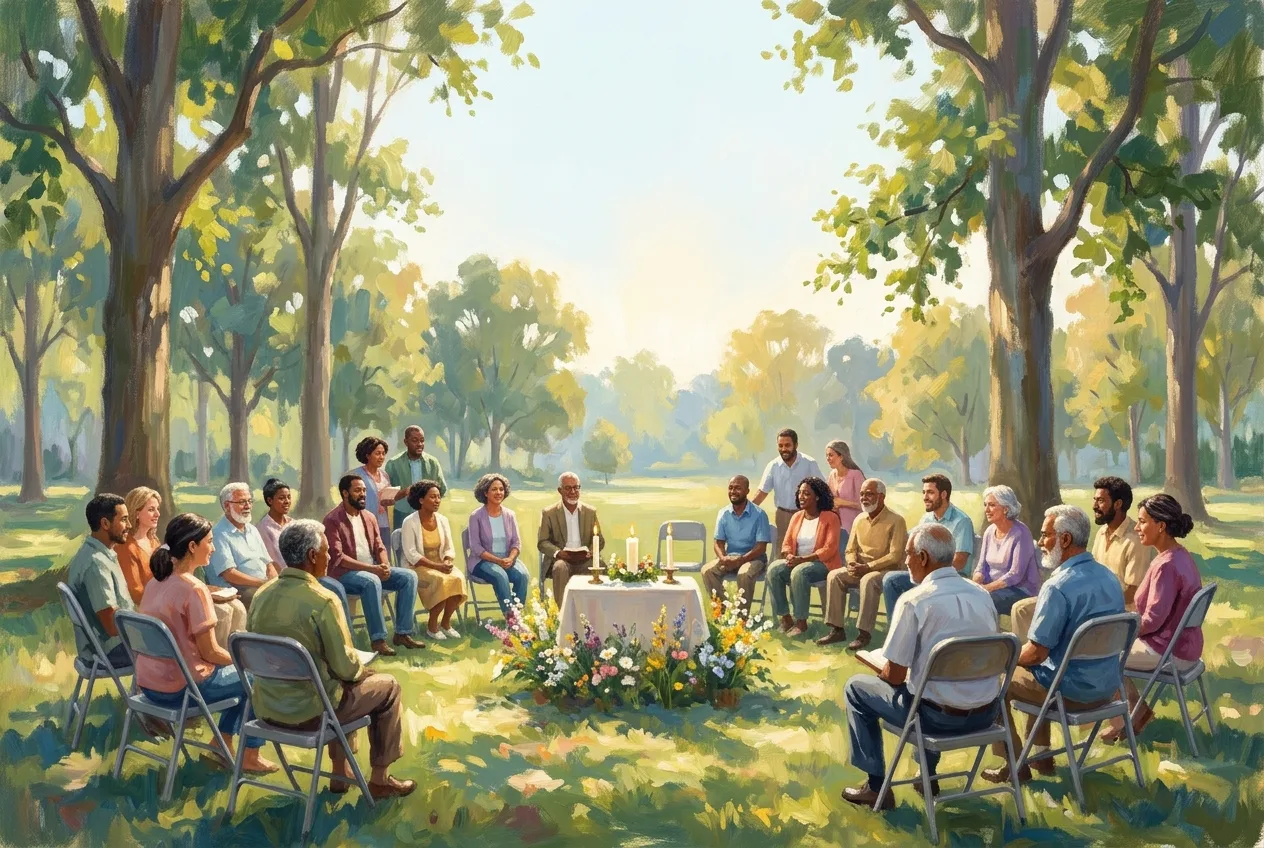
Outdoor worship for progressive churches. A diverse congregation gathered for outdoor worship in a sun-lit park, with portable chairs arranged in a circle and a makeshift altar in the center, impressionist style, loose expressive brushstrokes, dappled natural light, painterly atmosphere

Outdoor Worship for Progressive Churches:

A Planning Guide

There is something that happens when you move worship outside.
The quality of attention changes.
People sit differently.
The sounds that interrupt — birds, wind, a distant lawnmower,
a child who wanders off to examine something in the grass
— no longer feel like failures of decorum.
They feel like participation.

For progressive, mainline, and creation-care-centered congregations, outdoor worship is not just a logistical option for summer. It is a theological practice. It places the community inside the creation that the community is called to protect. It makes the sanctuary permeable. It invites the world in — or rather, it takes the community out into the world where it belongs.

This guide is for worship leaders and ministry teams who want to take worship outside this summer and do it well — with intention, good liturgy, solid logistics, and visual materials that honor the beauty of the setting.

The Theology of Outdoor Worship

Before you plan a single detail, it is worth spending a few minutes with the theology of what you are doing — because the theology will shape every decision that follows.

Worship has been conducted outdoors for most of human history. The psalms are outdoor poems. Jesus preached on hillsides, from boats, by the sea. The earliest Christian communities gathered in homes and in open spaces, not in buildings. The built sanctuary is a beautiful thing — but it is a relatively recent development in the long history of the people of God gathering to encounter the holy.

When progressive congregations move worship outside, they are doing several things at once:

  • Participating in a practice as old as faith itself — reframing the out-of-doors not as a retreat from sacred space but as a return to it
  • Enacting creation theology — the conviction that the earth is not merely the backdrop for human spiritual life but is itself sacred, beloved by God, and owed our reverence and care
  • Breaking down the boundary between the worshipping community and the wider world — an act with genuine theological and political meaning for communities committed to justice and presence in the public square
  • Offering accessibility in a different register — outdoor worship can lower the threshold for people who find institutional religious spaces intimidating or exclusionary

That last point deserves emphasis. For some people — those who have been hurt by the church, those who are spiritually curious but institution-averse, those who experience the outdoors as their primary place of transcendence — an outdoor worship service is a more genuine invitation than anything that happens inside a building. Name this in your publicity and in your service itself.

Outdoor Worship and Ordinary Time

Outdoor worship is an Ordinary Time practice in the most literal sense: it happens during the Ordinary Time weeks of summer, and it embodies the theology of that season.

Ordinary Time is the season of growth, of patient attention to the slow work of the Spirit, of the sanctification of the everyday. There is no more ordinary thing than a summer morning in a park, and there is no more extraordinary thing than a community gathered in that ordinary space to pray, to sing, to break bread, to listen for God.

When you frame outdoor worship explicitly as an Ordinary Time practice — when you tell your congregation that what you are doing on a Sunday morning in July is part of the church's ancient practice of the long season — you give the experience a liturgical depth that it might otherwise lack. You are not just holding church outside. You are practicing the theology of the season in the most embodied way possible.

Consider incorporating an explicit Ordinary Time reflection into your outdoor service — a brief framing moment in which the worship leader names the season, names what the community is doing in it, and invites the congregation into the particular attentiveness that Ordinary Time asks of us.

The concepts explored here also work well if you are adding an outdoor element to your summer/VBS programs for children.

Planning Your Outdoor Worship Service

Choose Your Space Intentionally

The space is not neutral. Where you worship outdoors says something about who you are and who you are worshipping with.

Some options and their theological resonances:

  • Your own church grounds or garden — accessible, familiar, requires least logistical coordination; good for first outdoor services; theological note: the church's own land as sacred space
  • A public park — sends a signal of openness and welcome; visible to passersby; invites the community into a shared civic space; good for congregations with a strong public witness identity
  • A nature preserve, trail head, or waterfront — strongest creation theology resonance; best for smaller, more mobile congregations; less accessible for people with mobility limitations
  • A member's farm, garden, or outdoor property — intimate, community-building; works especially well for harvest-themed or creation care services
  • A neighborhood location with community significance — a park near a shelter, a vacant lot being reclaimed for a garden, a community space associated with justice work — can turn outdoor worship into an act of solidarity and witness

Whatever you choose, visit the space in advance at the time of day you plan to worship. Note where the sun will be, where sound will carry, where people will face. Scout for accessibility — uneven ground, distance from parking, availability of seating — and plan accordingly.

Design the Liturgy for the Space

The most common mistake in outdoor worship is taking the indoor service outside unchanged. Outdoor space requires outdoor liturgy — and that is an invitation, not a burden.

Several liturgical principles apply specifically to outdoor worship:

  • Shorter is better — outdoor attention spans differ from indoor ones, and that is not a criticism of your congregation. Design for 45 to 55 minutes maximum unless your community has strong outdoor worship culture already.
  • Use the space as liturgy — open with a call to worship that names where you are: "We have gathered in this place, under this sky, beside these trees, with the earth beneath our feet." Let the setting do theological work.
  • Plan for acoustic challenges — voices scatter outdoors in ways they don't inside. Test your sound system or amplification in advance, and design the service with simplicity of participation in mind: spoken responses that are easy to hear and repeat, songs people know well, silence that is intentional rather than confused.
  • Make the bulletin simple and large-print friendly — sunlight makes small text hard to read. A single folded sheet in a larger font works better than a multi-page program.
  • Build in the unexpected — a moment for people to name something they notice in their surroundings, a brief silent observation walk before the service, a time of open prayer that explicitly invites the congregation to pray about what they see and hear around them.
Music Outside

Music is one of the most challenging and rewarding aspects of outdoor worship. The acoustic environment is completely different — sounds that ring beautifully in a sanctuary scatter and thin outdoors.

What works well:

  • Songs the congregation knows by heart, so they don't need to follow printed lyrics
  • Rounds and simple refrains — Taizé chants are exceptionally well-suited to outdoor worship
  • Acoustic instruments, which project more naturally outdoors than amplified ones in many settings
  • Drumming and percussion, which carry well and have deep roots in outdoor communal worship
  • Singing in a circle, which improves ensemble cohesion dramatically compared to rows

What requires extra planning:

  • Amplified instruments and PA systems — test for feedback and coverage before the service
  • Complex choral arrangements — save those for indoors; simplify the outdoor music program
  • New songs — outdoor worship is not the moment to introduce unfamiliar repertoire; build the service around songs the community already loves
Communion Outside

Outdoor communion is one of the most theologically powerful acts a progressive congregation can offer. The eucharistic table in a park, by a river, in a garden — this is not a diminished version of indoor communion. It is communion in its original context: a meal shared among friends, in the world, under the open sky.

Practical notes:

  • Use a simple table or cloth on the ground as your communion table — the visual simplicity is itself a theological statement
  • Bread that breaks easily by hand is better than wafers outdoors; a common loaf, broken and passed, is both practical and beautiful
  • Wine or juice in a common cup, or individual cups — plan for wind and spillage
  • Keep the words of institution unhurried and direct; outdoors, the sacrament tends to feel self-evident in ways that don't require elaborate explanation

Consider combining outdoor communion with Water Communion if you are planning a late-summer service — the two rituals together create a powerful liturgical statement about community, creation, and the gathered life of faith. See our full guide to Water Communion for planning details.

Logistics and Accessibility

Good outdoor worship theology is undermined by poor logistics. Work through these practicalities before the day:

  • Seating — bring enough chairs for everyone expected, plus extras; consider a mix of chair types for different body needs; have a shaded area available
  • Sun and heat — schedule morning services before the heat peaks; provide water; have sunscreen available; consider shade structures or select a naturally shaded location
  • Weather contingency — have a clear rain plan and communicate it in advance; do not make the decision morning-of if you can avoid it
  • Sound amplification — at minimum, a portable speaker and a single wireless microphone; test in the space before the service
  • Children — outdoor worship is often more accessible and enjoyable for children than indoor services; lean into this rather than apologizing for it; designate a nearby area where children can move freely without disrupting the service
  • Restrooms — know where the nearest facilities are and communicate this to attendees in advance
  • Permissions — if you are using a public park or non-church property, secure any necessary permits well in advance

Writing Outdoor Liturgy with PCM Lumen

Outdoor worship calls for liturgy that is responsive to the specific space, season, and theological intentions of your service — and writing original prayers, calls to worship, and blessings from scratch takes time that many worship leaders don't have in the busy weeks of summer.

PCM Lumen is an AI writing tool built for progressive church contexts. Use it to draft outdoor-specific liturgy: a call to worship that names your specific location and the theology of creation, a communion prayer suited to an outdoor setting, a closing commissioning that sends people into the world they have just been worshipping within.

PCM Lumen logo with sun icon and gradient purple pink background, vertical layout

Sample PCM Lumen Prompt: Outdoor Call to Worship

Copy and adapt this prompt in PCM Lumen. Select the Sermon Prep tab, then Liturgy and pick which "lens" you want to use to organize your thoughts:
Write a call to worship for a progressive congregation holding outdoor worship in a public park on a Sunday morning in summer. The theological theme is creation care and Ordinary Time — the idea that the long, slow, green season of summer is itself a form of sacred time. The tone should be grounded and wonder-filled, not sentimental. Include a congregational response line that can be repeated three times throughout. Avoid language that positions nature as merely a metaphor for human spiritual experience — treat the creation as itself sacred and beloved by God. Length: approximately 200 words.

Free 14-day trial - no credit card required
What Lumen produces: a full call to worship with congregational response, theologically grounded in progressive creation theology, ready to adapt for your specific setting and community voice.

Creating Outdoor Worship Visuals with PCM Imago

Even outdoor worship benefits from visual materials — digital bulletins, social media announcements, slide backgrounds for projected screens, and graphics that help your community invite others to the service.

PCM Imago is an AI image generator with inclusive, theologically-grounded presets. It produces imagery that reflects the actual diversity of progressive communities rather than the narrow visual defaults of conventional church media.

Sample PCM Imago Prompt: Outdoor Worship Announcement Graphic

Use this prompt in PCM Imago to generate visual materials for your program.

In PCM Imago, select Visual Mode: Illustration, Preset: Other, then add Topic: Outdoor Worship. Add any Art Style and Format you prefer:
Create a social media announcement graphic for a progressive, inclusive church holding outdoor summer worship in a local park. The image should show a diverse congregation — people of different races, ages, and abilities — gathered in an outdoor setting with warm summer light filtering through trees. The mood should be joyful, relaxed, and welcoming rather than formal or institutional. Leave space at the bottom of the image for text overlay with service details. Color palette: warm greens, golds, and sky blues. Style: painterly and warm, not stock-photo generic.
Try your first image for free
Use Imago to generate your outdoor worship announcement graphic, a digital bulletin cover, and social posts in the days leading up to the service. Consistent, beautiful visuals build anticipation and make the invitation feel compelling rather than perfunctory.

Making Outdoor Worship a Summer Series

A single outdoor service is a lovely thing. A summer series of outdoor worship becomes a formation practice — something the community builds memory and expectation around, something that shapes how the congregation understands its relationship to the created world and to the season.

Consider anchoring a four- to six-week summer outdoor worship series around the Ordinary Time themes that already anchor the season:

  • Week 1: Creation and Sabbath — What does it mean to rest in the world God made?
  • Week 2: The Body of Christ in the Open Air — Communion outdoors as an act of public faith
  • Week 3: Neighbors Near and Far — Outdoor worship as a practice of presence in the community
  • Week 4: Water and Life — Connecting to the watershed, the water cycle, and the theology of water (a natural lead-in to Water Communion in September)
  • Week 5: Creation Care as Discipleship — What does faithful stewardship of the earth look like in the actual neighborhood where your church is located?
  • Week 6: Sending into the Ordinary — A closing service that commissions the congregation for the work of Ordinary Time before the fall program year begins

Each week can include a brief creation-focused action or reflection — picking up litter at the park, planting something, learning the name of one bird or tree species present in your worship space — that connects liturgy to embodied practice.

Frequently Asked Questions

What if it rains?
Have a plan and communicate it clearly before the day. The two most common approaches are: (1) a simple cancellation with the service moving indoors on the same day, or (2) a move to an indoor backup location that is set up in advance. Whatever you choose, send a clear communication by 7 a.m. on the morning of the service so families can plan accordingly. Ambiguity on rain days erodes trust and attendance.

How do we handle amplification for a larger congregation?
For congregations over 75-100 people, a basic PA system with a wireless handheld or lavalier microphone and two speakers positioned to project toward the congregation (not away from it) is the minimum. Test this setup in the space during the same time of day as the service — ambient sound and wind conditions vary significantly. A small investment in a quality portable PA system pays dividends across multiple outdoor services.

Is outdoor worship appropriate for formal liturgical traditions like Episcopal or ELCA congregations?
Absolutely — and the history of outdoor worship in these traditions is rich. Many Episcopal and Lutheran congregations hold outdoor communion services on feast days, in churchyards, and at summer camp chapels. The liturgy of the BCP or ELW adapts gracefully to an outdoor setting; what changes is the environment, not the substance of the rite. Some liturgical traditions even have specific rites for blessing of the fields, outdoor rogation processions, and harvest services that are designed for outdoor use.

How do we make outdoor worship accessible for people with mobility limitations?
Accessibility planning is non-negotiable — and it is a theological issue, not merely a logistical one. Choose a space with level ground and accessible pathways. Provide seating for everyone, not just those who ask. Position the altar, presider, and speakers so they are visible and audible from a seated position at the edges of the gathering. Have a volunteer available specifically to assist anyone who needs help navigating the space. Communicate accessibility details in your advance publicity so people can plan.

Can we live stream or record an outdoor service?
Yes, and for many congregations this significantly extends the reach of outdoor worship. The main challenge is wind noise on microphones — use a windscreen or "dead cat" cover on any exterior microphone, and position your camera or phone away from the primary wind direction. Many communities find that outdoor services stream particularly well because the visual environment is naturally compelling and the relaxed, spacious energy of outdoor worship translates effectively to a screen.

Copyright © 2026 Progressive Church Media
Visa
MC
AMEX
Discover