No products in the cart.
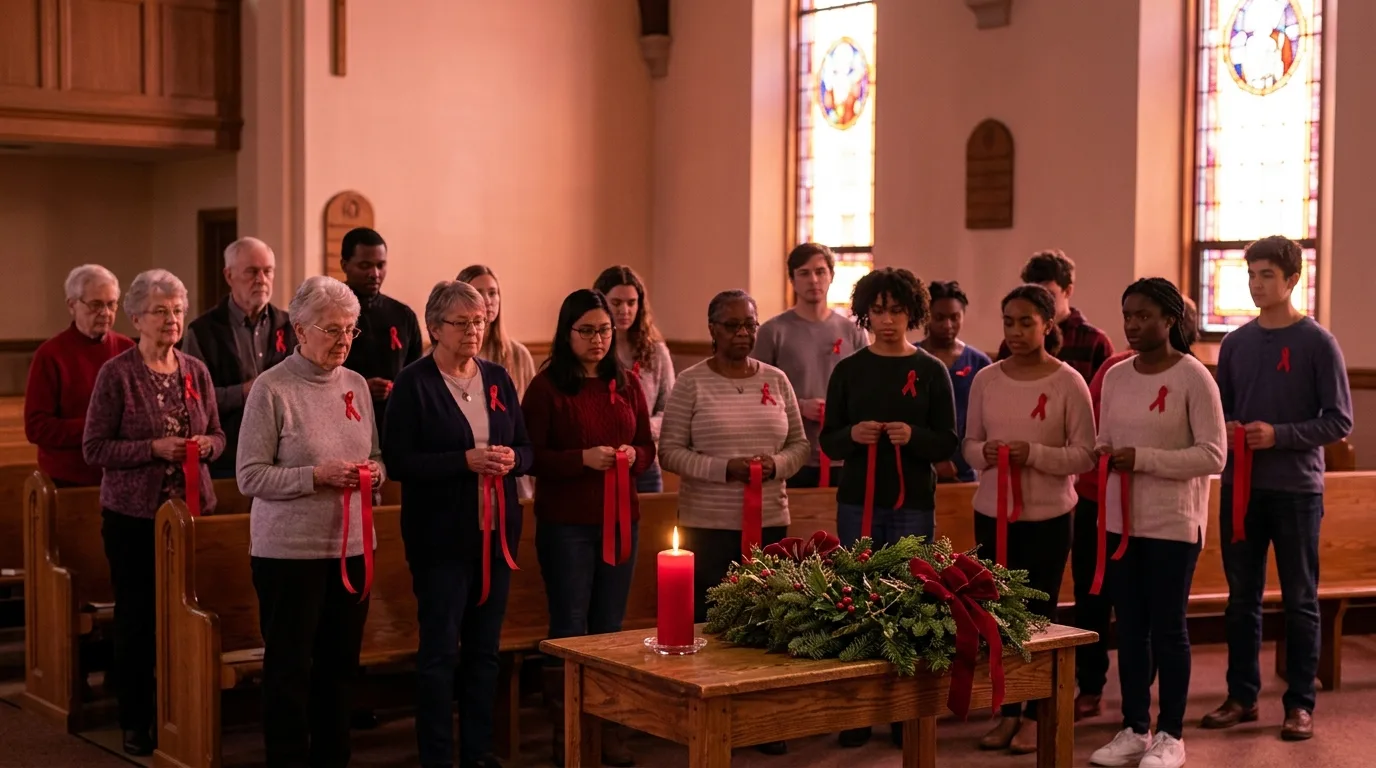
Every December 1, the world stops to remember the tens of millions of people AIDS has taken and to stand with the millions living with HIV today. For progressive and affirming congregations, it is also a day to tell the truth about the church’s part in the story — and to be the church that shows up now.
This page gives you everything you need to mark World AIDS Day in worship: a free, complete liturgy built around a reading of the names, guidance on the calendar, pastoral notes for the people in your pews, scripture for preaching, and worship media for the day.
Free download · Every year · No attribution required
A complete service for December 1 or the Sunday nearest it, in any year. Eleven pages, with leader notes, ready to print, project, or adapt.
Download the free World AIDS Day liturgyFree, instant PDF. You will not be charged.
World AIDS Day was first observed on December 1, 1988, established by the World Health Organization to bring global attention to the epidemic and to the people living with it. Its symbol, the red ribbon, was created by artists in New York in 1991 and has been worn ever since as a sign of remembrance and solidarity.
The day holds two things at once. It is a memorial for the people who died, many of them young, many of them buried by friends because their families or their churches would not. And it is a public witness for the roughly 40 million people living with HIV around the world today — most of whom, with access to treatment, can expect long and ordinary lives. A congregation that marks the day should make room for both.
World AIDS Day is fixed on December 1, so it moves across the days of the week. The Sunday nearest December 1 is always the first or second Sunday of Advent. Most congregations that observe the day in worship do it then. Some keep it a week early, on Reign of Christ, the last Sunday of the church year, so that Advent can begin on its own terms. A third option is a short service on the evening of December 1 itself.
The free liturgy works in all three. Nothing in it depends on the season, and it includes a section of adjustments for an Advent Sunday — how to hold the Advent wreath and the World AIDS Day candle side by side without asking either to carry the other’s meaning.
A Liturgy for Speaking the Names is written for progressive, affirming, and mainline congregations, in expansive language. It does not treat HIV as a moral category, and it does not pretend the church was a bystander. Inside, you will find:
Download the World AIDS Day liturgy — it is free, and it is yours to adapt.
The heart of the service is simple: people your congregation has lost, spoken aloud by name. It is the same instinct behind the AIDS Memorial Quilt, begun in San Francisco in 1987 so that the dead would be remembered as people rather than as a number.
In the first years of the epidemic, prominent preachers told their congregations and television audiences that AIDS was the judgment of God. Many churches refused funerals, and many more said nothing. Partners were turned away at hospital doors and left out of obituaries, and families were told their grief was a scandal.
That is not the whole story. Congregations — many of them queer-led — buried their own members and held the funerals others refused, and chaplains, nurses, and volunteers from across the church sat at bedsides when no one knew what was safe. Both belong in a World AIDS Day service. The free liturgy includes a confession for congregations with their own history to name, and a prayer of thanksgiving for those who showed up.
The Gospel had the answer all along. In John 9, the disciples see a man suffering and ask whose sin caused it. Jesus refuses the question. A World AIDS Day sermon can start right there.
Is communion safe to share? Yes. HIV is not transmitted by sharing bread or a common cup. If your congregation offers intinction or individual cups, do it for your usual reasons — never because someone living with HIV is at the table.
Keep the color the day already gives you: purple or blue on an Advent Sunday, white if you keep the day on Reign of Christ. There is no World AIDS Day color for the altar. The red ribbon belongs on people — hand them out at the door and invite everyone to wear one out of the building.
| Reading | Why it fits |
|---|---|
| John 9:1–7 | The disciples ask whose sin caused the man’s condition, and Jesus refuses the question. |
| Mark 1:40–45 | Jesus touches a man whose disease made him untouchable, before a word of healing is spoken. |
| John 11:32–36 | Jesus weeps at the grave of his friend, and does not hurry past the grief. |
| Psalm 88 | The psalm that ends in darkness. Some grief is not ready to be resolved, and scripture makes room for it. |
| Romans 8:35–39 | Nothing in all creation can separate us from the love of God — not death, not life, not a diagnosis. |
| Matthew 25:31–46 | “I was sick and you took care of me.” The gospel for Reign of Christ in Year A, and a text for this day in every year. |
The free liturgy includes five more readings with notes, including 2 Samuel 1, Ezekiel 37, and Revelation 21.
Pair the liturgy with visuals built for the day: red ribbon and remembrance designs for your screens, a worship service video, PowerPoint backgrounds, and social media graphics to invite your community.
Browse the World AIDS Day collection
Looking for a single piece? The World AIDS Day Worship Service Video opens a service or introduces the reading of the names.
PCM Complete members download every World AIDS Day resource — and every Advent, Christmas, and Epiphany set that follows it — with one annual membership. No auto-renewal, and everything you download is yours to keep.
Join PCM CompleteWant a prayer of the people that names your own community, or a bulletin note in your congregation’s voice? PCM Lumen is an AI writing tool built for progressive ministry. It will never write your sermon, but it can help you draft the words around it.
When should churches observe World AIDS Day?
World AIDS Day is December 1. The nearest Sunday is always the first or second Sunday of Advent, which is when most congregations mark it in worship. Some keep it a week early on Reign of Christ, and some hold a short service on the evening of December 1.
Is there a free World AIDS Day liturgy for churches?
Yes. Progressive Church Media offers a free, complete World AIDS Day liturgy built around a reading of the names, with a confession, prayers of the people, and leader notes. It can be used in any year.
What liturgical color is used for World AIDS Day?
Keep the color of the day: purple or blue in Advent, or white on Reign of Christ. World AIDS Day has no altar color of its own. The red ribbon is worn by people.
Is it safe to share communion with someone living with HIV?
Yes. HIV is not transmitted by sharing bread or a common cup.
What scripture fits a World AIDS Day service?
John 9:1–7, where Jesus refuses to say whose sin caused a man's condition. Also Mark 1:40–45, John 11:32–36, Psalm 88, Romans 8:35–39, and Matthew 25:31–46.