No products in the cart.
Transgender Day of Remembrance falls on Friday, November 20, 2026. Congregations marking it in Sunday worship will do so on November 22, which is also Reign of Christ and the Sunday before Thanksgiving.
If your congregation has never observed Transgender Day of Remembrance (TDOR), this is where to start. If you observe it every year and want something you do not have to write from scratch again, the liturgy below is free, complete, and yours to adapt.
One assumption runs through this whole page: transgender and nonbinary people are already in your congregation. They are in the pews, on the council, and in the choir, and they will hear whatever you say about them. Everything here is written for a room that includes them.
Transgender Day of Remembrance began in 1999, when Gwendolyn Ann Smith organized a vigil for Rita Hester, a Black transgender woman killed in Massachusetts the year before. Her murder was never solved. The vigil became an annual observance, and is now marked in hundreds of cities worldwide on November 20, at the close of Transgender Awareness Week.
The central practice is simple and old: the names of transgender people killed in the past year are read aloud, slowly, with silence between them. Most of the names, every year, belong to Black and Latina trans women. That has been true since the first vigil, and it is the part of the observance that congregations most often soften. Do not soften it.
TDOR is not a feast of the church year. It has no assigned readings and no assigned color. It is a civic observance that many congregations have taken into worship because the church has a long practice of naming the dead and refusing to let them be forgotten, and because the church also has a great deal to answer for in how transgender people have been treated in its name.
In 2026, one Sunday carries three claims. November 22 is Reign of Christ, the last Sunday before Advent. It is the Sunday before Thanksgiving. And it is the Sunday most congregations will use to observe TDOR, since November 20 is a Friday.
You do not have to choose between them, and the choice is easier than it looks once you stop treating TDOR as a separate service that must be squeezed in.
Inside a Reign of Christ service, a remembrance reads as the reign of Christ meaning something specific about who is safe and who is not. The Sunday is already about where real authority lies. Naming people killed by the ordinary authority of law and custom is not a detour from that text; it is the text.
Inside a Thanksgiving service, a remembrance keeps the gratitude honest. A congregation that can only give thanks when nothing is wrong has not learned much about thanksgiving. Naming the dead and then giving thanks is harder and truer than doing either alone.
If your congregation would rather give the observance its own room, hold a vigil on Friday evening, November 20, and keep Sunday for Reign of Christ. Both are good decisions. What is not a good decision is quietly skipping it because the calendar is crowded.
PCM publishes a complete twelve-page liturgy for TDOR, free to print, project, adapt, and reprint, with no attribution required.
It includes a word of welcome, a responsive call to worship, a prayer of invocation, a scripture table with planning notes, a prayer of lament, guidance on choosing and reading the names, the naming itself, a full blessing of the living, a congregational commitment, a sending, four card texts, and hymn suggestions.
Every section is modular. The naming and the blessing together make a complete rite in under ten minutes, which is what makes it possible to place inside a service already carrying Reign of Christ or Thanksgiving. For a standalone vigil, the whole order works as written.
One part is deliberately not optional. After the naming comes a blessing spoken directly to the transgender and nonbinary people present, with separate blessings for someone who has chosen a new name, for parents learning a new name and pronoun, for families who became family when the first one would not, and for anyone who is simply afraid. A service that mourns transgender people without blessing the transgender people in the room has told them what the church expects of their future. Nobody is asked to stand, come forward, or identify themselves; every blessing is written to be received sitting still.
Two organizations publish annual records that most congregations work from. Remembering Our Dead tracks deaths worldwide. GLAAD publishes US-focused TDOR resources, and the Human Rights Campaign issues an annual report on fatal violence against transgender and gender non-conforming people.
Treat all of them as reference material. The list your congregation reads is yours to determine, and no one outside your community should determine it for you.
Congregations take different approaches, and each of them is defensible. Some read every recorded name, and the service runs long on purpose, because the length is the point. Some read only names from their own country or state, so the geography lands close. Some read local names alongside the published ones. Some hold the whole list in silence and read none of it aloud, because a list read badly is worse than a list held well.
Decide in advance, and decide with transgender members of your congregation in the room when you decide it. This is the single most common way churches get TDOR wrong: planning a service about a group of people without any of those people present for the planning.
When you do read, read slowly, and leave more silence between names than feels comfortable. Some names are recorded only as unknown. Say that too. A person whose name was never written down is still a person, and the failure of record is ours rather than theirs.
Announce the observance in advance, in the newsletter and from the pulpit, so nobody walks into it unprepared. Someone in your congregation has lost a friend this year. Someone has a trans child. Someone is trans and has not told you.
Name a specific person who will be available for conversation afterward, and say who it is at the start of the service rather than at the end. People decide whether to stay during the service, not after it.
During the service, do not ask transgender or nonbinary people to stand, raise a hand, come forward, or speak. Nobody should be outed by an order of service.
For the bulletin on the day itself, there is a free half-page insert. It explains what Transgender Day of Remembrance is and why your church keeps it, speaks directly to transgender and nonbinary people without asking anyone to identify themselves, and leaves a line to name the person available afterward. It prints two to a letter sheet on any black-and-white copier, and the Word version is fully editable. It carries no branding, so it reads as your congregation's own.
Children can be present. Nothing in this liturgy describes violence, and none should be added. The word killed is sufficient, and it is the truth.
Afterward, do not let the room empty in silence into a dark parking lot. Coffee, light, and someone standing near the door matter more than the closing hymn. Follow up during the week with anyone the service seemed to land hard on.
Transgender Day of Remembrance carries no assigned liturgical color, because it is not a feast of the church year. If you observe it on Sunday, November 22, the day is Reign of Christ and the color is white. Keep it.
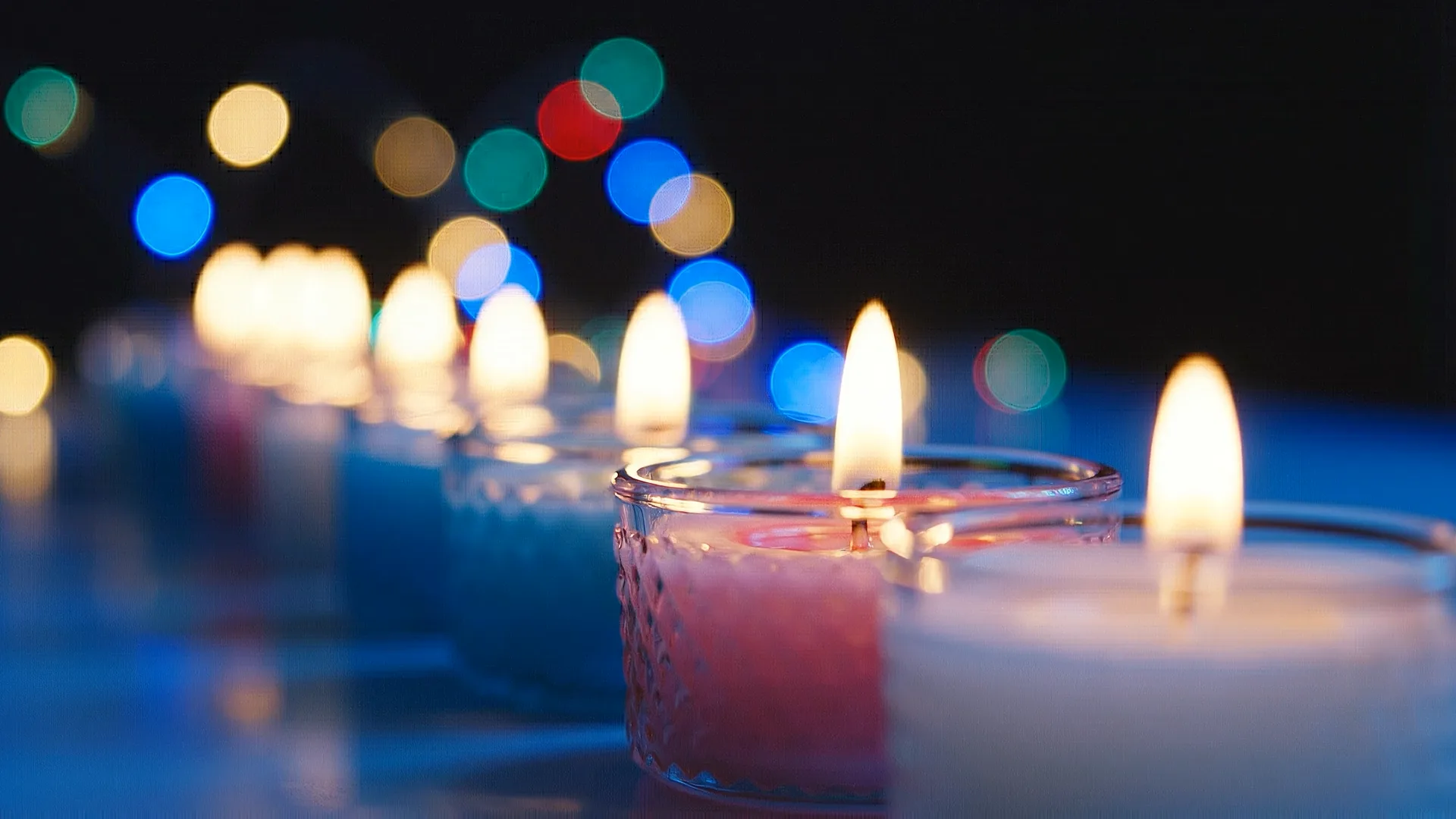
The trans flag colors, light blue and pink and white, belong in candles, ribbons, and cloth on a memorial table. Putting them on the paraments reads as replacing the church's calendar rather than using it, and hands an objection to anyone looking for one. A single candle per name, or three pillar candles in the flag colors beside the table, does the visual work without that cost.
Isaiah 56:3 to 5 is the spine of this observance. The eunuch is told not to call himself a dry tree, and God promises a name inside the house, better than sons and daughters. If you preach one text, preach that one.
Acts 8:26 to 40 puts the same figure on a desert road, reading scripture and asking what could possibly prevent him from being baptized. Nobody answers, because there is no answer.
Psalm 139:1 to 18 is for the living rather than the dead: known before being formed, searched through, and loved anyway. Revelation 2:17 gives a white stone with a new name on it, which lands differently in a congregation that includes people who chose their names. Isaiah 43:1, Matthew 19:12, and Galatians 3:28 all carry weight here as well.
Genesis 1:27 deserves separate treatment, because it is the verse most often quoted to tell transgender people they do not exist. It is worth taking back rather than avoiding. The same chapter says God separated evening from morning, and nobody concludes from that there is no such thing as noon. It says God separated the sea from the dry land, and nobody has ever stood on a beach and denied that a beach is there. Hebrew poetry names the two ends of a thing to mean the whole of it. Male and female is the whole human creation, held between two named ends, and everything between them is inside the blessing that closes the day. The verse has been used as a fence for a long time. It was written as a horizon.
Deuteronomy 22:5 is the other text people will raise. It is worth knowing what it actually says and what it was for before it comes up in coffee hour.
We offer a TDOR worship video built for exactly this service, along with a Trans Inclusion collection and a wider library of affirming worship graphics, slides, and social templates. Most of the catalogue is available in English and Spanish.
If you are projecting the liturgy, the card texts at the end of it work as slides with very little adaptation.
Tell your transgender members before you tell the council. Ask whether they want this, and what they want it to be. Then decide how you will handle the names, name the person available for pastoral conversation, order candles, and keep the rest of the service simple. A first observance that is short, plain, and well-cared-for is better than an ambitious one nobody was consulted about.
How to be an Open and Affirming Congregation
Create A Gender-Affirming Restroom Policy For Your Church
Cross-Dressing: What Does Scripture Say?
World AIDS Day Liturgy for December 1
When is Transgender Day of Remembrance 2026?
November 20, 2026, which falls on a Friday. Congregations observing it in Sunday worship generally do so on November 22, which is also Reign of Christ.
What is the liturgical color for Transgender Day of Remembrance?
There is none assigned, because TDOR is not a feast of the church year. If you observe it on Sunday, November 22, the day is Reign of Christ and the color is white. Trans flag colors are better used in candles and cloth than in paraments.
Where do churches get the names read at Transgender Day of Remembrance?
Remembering Our Dead and GLAAD both publish annual records, and the Human Rights Campaign issues an annual report. Treat them as reference. The list your congregation reads is yours to determine, ideally with transgender members involved in the decision.
Can a church observe TDOR and Reign of Christ on the same Sunday?
Yes. A remembrance of ten minutes or less fits inside a Reign of Christ service without displacing it, and the two texts speak to each other directly, since Reign of Christ is already a question about where real authority lies.
Is the Transgender Day of Remembrance liturgy free?
Yes. It is free to print, project, adapt, and reprint, with no attribution required, though attribution is always welcome.
Is the service appropriate with children present?
Yes. The liturgy describes no violence, and none should be added. The word killed is sufficient and truthful, and children are generally better served by a plain answer than by an absence they notice anyway.