No products in the cart.
This guide is part of our complete guide to the Halloween, Día de los Muertos, and All Saints season
Día de los Muertos is a Mexican observance, rooted in Indigenous and Catholic traditions, held on November 1 and 2 — the same days as All Saints' Day and All Souls' Day. Far from somber, it is warm and colorful: families build altars, share meals, tell stories, and trust that the boundary between the living and the dead grows thin enough for memory to feel like presence.
At its heart is a profound and hopeful conviction — that those we love are not gone so long as they are remembered, named, and celebrated. For Christians, that conviction rhymes deeply with the resurrection hope and with the ancient belief in the communion of saints: that we remain bound, across death, to the great cloud of witnesses who came before us.
Yes — and for many congregations it's a meaningful fit. You may have encountered the loud objection that frames the Day of the Dead as something un-Christian to be resisted. That posture misreads both the observance and the church's own tradition.
The truth is that Día de los Muertos and the Christian All Saints season grew up together. November 1 and 2 are not a coincidence; the Day of the Dead is woven through with Catholic devotion to the saints and the faithful departed. A church that honors this observance isn't importing something foreign — it's recognizing a tradition that has always lived alongside its own, and welcoming the families for whom it is part of both their faith and their heritage.
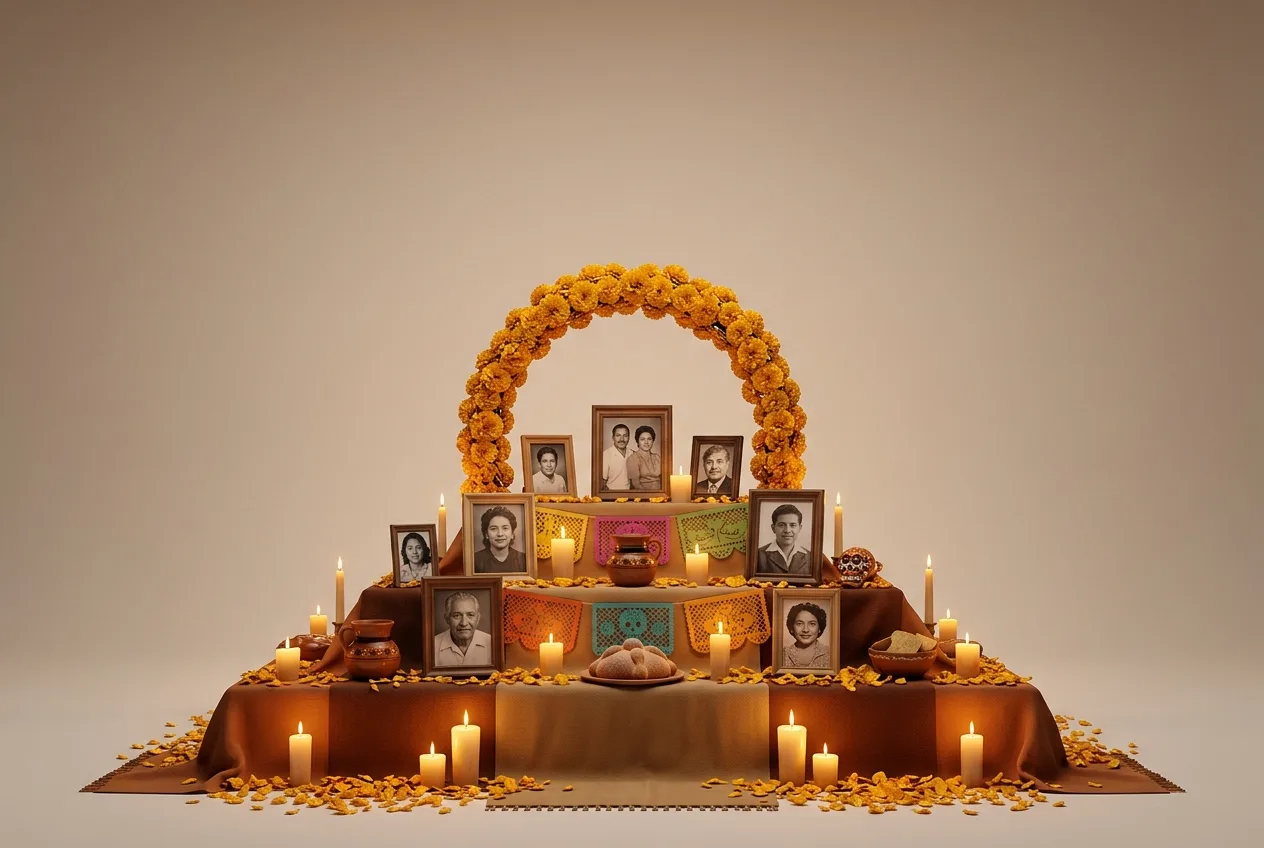
The center of Día de los Muertos is the ofrenda — the altar families build to welcome the memory of the dead. A church can create a communal ofrenda that invites the whole congregation to bring their beloved dead into the same sacred space.
Traditional elements each carry meaning: photographs of those who have died; cempasúchil (marigolds), whose color and scent are said to guide the spirits home; candles for light and prayer; pan de muerto (bread of the dead) and favorite foods; water to refresh the weary traveler; and papel picado, the cut-paper banners that represent the fragility of life. Calaveras — the sugar skulls — appear not as morbid symbols but as joyful, even playful, reminders that death need not be feared.
Set up a table in the narthex or worship space in the days before November 1. Invite members to bring framed photographs and the names of those they wish to remember. Many churches pair this with a slip of paper where people can write a name to be read aloud during worship. The altar becomes a living act of the congregation's grief and gratitude, held together.
The observance integrates beautifully with an All Saints' or All Souls' service. A few ways congregations do it:
Read the names of those who have died in the past year — and invite the congregation to add the names on their hearts — as candles are lit at the ofrenda. Use bilingual liturgy and song, so the worship itself reflects the community it serves. Preach the communion of saints: the long, unbroken company of the faithful, living and dead, of which this gathered congregation is one small part. And let the visuals carry the spirit — marigold golds, deep purples, and the warm, celebratory color that distinguishes this observance from a purely mournful one.
Bringing the color and warmth of Día de los Muertos into worship is far easier with ready-made bilingual visuals. Progressive Church Media's Día de los muertos collection is built in both English and Spanish, with social media templates to invite your community, worship graphics and PowerPoint slides for the service itself, and video resources including 4K. You'll find more in the Worship in Spanish collection and alongside the broader fall and All Saints resources.
When is Día de los Muertos?
Día de los Muertos is observed on November 1 and 2, coinciding with All Saints' Day (November 1) and All Souls' Day (November 2). Preparations, including building the ofrenda, often begin in the final days of October.
Is Día de los Muertos the same as Halloween?
No. While they fall in the same season, Halloween (October 31) and Día de los Muertos (November 1–2) are distinct. Día de los Muertos is a remembrance of the beloved dead with deep Indigenous and Catholic roots, centered on honoring loved ones rather than on costumes or candy.
Can a Protestant or progressive church observe Día de los Muertos?
Yes. Many mainline and progressive congregations — including UCC, ELCA, Episcopal, UMC, and PCUSA churches — observe Día de los Muertos alongside All Saints' and All Souls', particularly to welcome and honor Latino and bilingual members of their community.
What is an ofrenda?
An ofrenda is the altar at the heart of Día de los Muertos. It holds photographs, candles, marigolds, food, and mementos of those who have died. In a church setting, a communal ofrenda invites the whole congregation to bring their beloved dead into a shared space of remembrance.