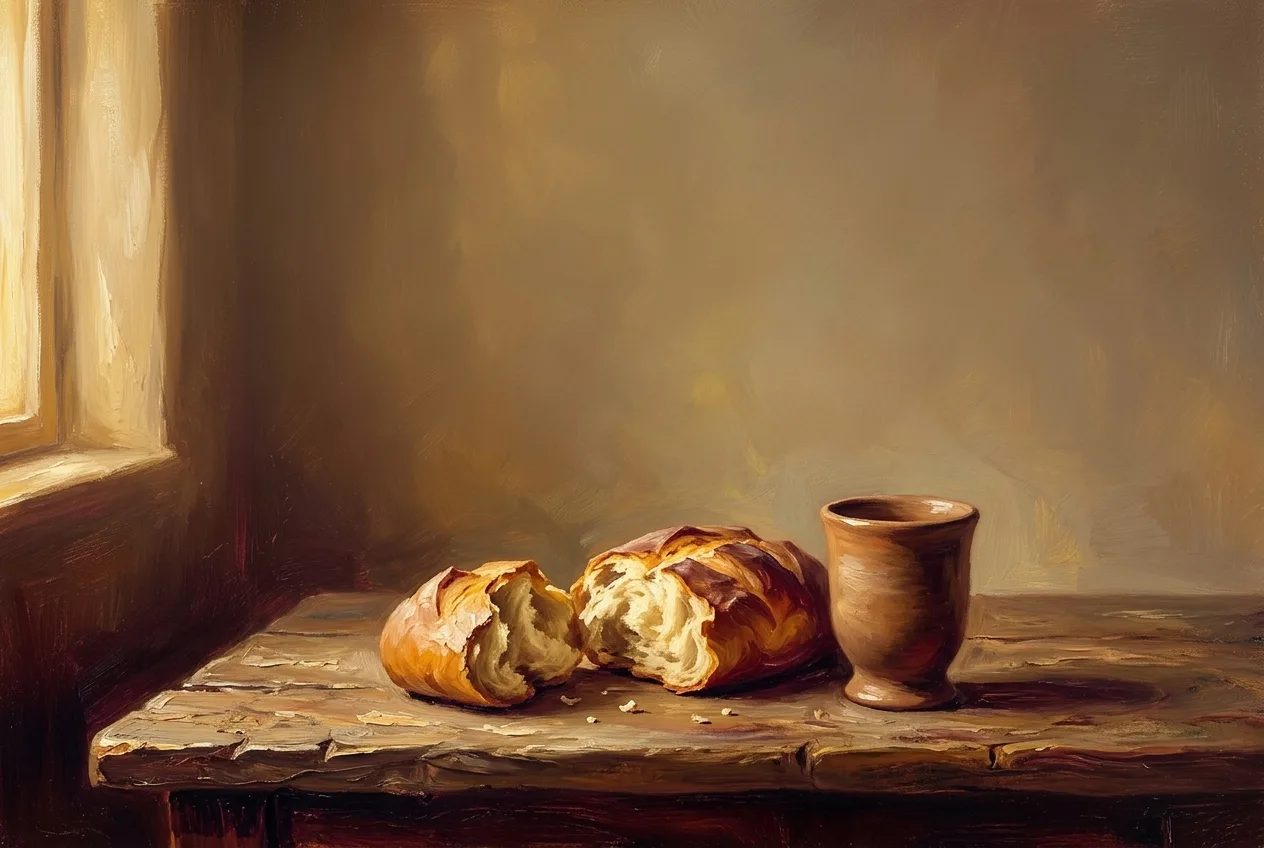
Sermonette topics for progressive churches. Bread and cup on a simple wooden table with soft natural light, communion meditation setting, oil painting, rich impasto texture, deep luminous color, painterly brushwork

Sermonette Topics

for Progressive Churches

Some moments in worship call for a full sermon. Others call for something smaller
— a single image, a brief word, one scriptural moment that opens a door
and trusts the congregation to walk through it.
That’s what a sermonette is for.

For progressive, mainline, and affirming pastors, the sermonette is an underused tool. It shows up at the communion table, before children are dismissed for their own programming, at the outdoor summer service with folding chairs and a borrowed lectern, at the mid-week gathering when the room is smaller and the conversation can be closer. It requires a different discipline than the Sunday homily: less argument, more image. One idea, carried far enough to land.

This guide offers 40+ sermonette topic ideas organized by occasion — the format in which pastors actually need them. Each topic includes a brief frame and a scriptural anchor. Pick one, open PCM Lumen, and start drafting.

What is a sermonette?
A sermonette is a short sermon — typically 5 to 12 minutes — focused on a single idea, image, or scriptural moment. It differs from the full homily not just in length but in craft: where a sermon develops an argument across multiple movements, a sermonette does its work through one strong image and a single clear invitation. In mainline and progressive traditions, sermonettes appear most often at communion, in all-ages worship, at outdoor and informal services, and at special occasions like stewardship Sundays or congregational meetings.

Communion & Eucharist Meditations

The communion table is one of the most natural homes for the sermonette. A 5–8 minute meditation before or after the elements can frame the sacrament theologically without displacing it. Progressive congregations often need content that articulates why the table is open, who belongs there, and what the act of eating together means.
  • The table as radical welcome — Who was at the last supper table, and who Jesus invited to tables throughout his ministry — the theologically and socially excluded. What does an open table cost, and what does it make possible? [Luke 14:12–14]
  • Bread as ordinary grace — The incarnation runs through matter — bread, water, oil, bodies. What does it mean to find the holy in the most common substance on earth? [John 6:35]
  • Do this in remembrance — Memory as a spiritual act. What we are doing when we remember together — not nostalgia, but a practice of making present. [Luke 22:19]
  • The meal that keeps going — From the last supper to the Emmaus road to the shore of Galilee — resurrection keeps happening at meals. What are we hoping will happen here? [Luke 24:30–31]
  • Enough for everyone — The feeding narratives aren’t about miraculous multiplication so much as about what happens when we stop hoarding. A sermonette on abundance theology and the practice of sharing.  [Mark 6:41–42]

We've also gathered a selection of Communion songs that celebrate an open table.

Craft Note:
Communion sermonettes work best when they end in stillness rather than a call to action. Trust the sacrament to carry the weight; the words open the door.

All-Ages & Intergenerational Moments

Many progressive congregations have a brief moment — often called the “children’s moment” or “family moment” — before younger participants move to their own programming. The best sermonettes for this context work on two levels: accessible enough for a seven-year-old, rich enough that the adults hear something too.
  • The mustard seed — Small things that become large things. What is the smallest act of courage, kindness, or justice you could do this week? [Mark 4:30–32]
  • Belonging and being known by name — The Good Shepherd calls each sheep by name. In a congregation, we learn each other’s names. What does it feel like to be known? [John 10:3]
  • Bread and fish: what sharing makes possible — The feeding of five thousand as a story about what happens when people stop keeping what they have to themselves. [John 6:9–11]
  • The lost sheep, the lost coin, the lost child — Three stories about things that get lost and are celebrated when found. Has anyone here ever felt lost? What found you? [Luke 15:1–32]
  • Building on rock — The sermon on the mount ending: what are the foundations we build our lives on? What makes something solid enough to last?  [Matthew 7:24–27]
Craft Note:
The all-ages sermonette should end with a question the whole congregation can sit with, not a moral lesson aimed at the children. Talk with them, not at them.

Outdoor & Informal Summer Services

Outdoor worship, park services, lakeside gatherings, and simplified summer liturgy all call for sermonettes that breathe. The setting does half the work — the sermon can be shorter, more contemplative, and less structured than a full indoor homily.
  • The holiness of the ordinary — Sabbath and the spiritual practice of noticing. What becomes visible when we slow down enough to see where we are? [Exodus 20:8–11]
  • Creation as revelation — What does the natural world teach us about God that scripture alone can’t? The tradition of natural theology for progressive congregations. [Psalm 19:1–4]
  • Elijah under the broom tree — The prophet who burns out, sleeps under a tree, and is fed by an angel. What does God’s response to exhaustion look like? [1 Kings 19:4–8]
  • The lilies of the field — Jesus’s case for slowing down — not as spiritual bypass but as re-orientation. What are we anxious about, and what does this moment actually ask of us? [Matthew 6:28–30]
  • Sabbath as gift, not obligation — Rest as a theological act, not a reward for productivity. What would change if we treated rest as sacred rather than earned? [Mark 2:27]
  • Where is the holy ground? — Moses and the burning bush: the holy shows up in ordinary places, when we’re doing ordinary work, and it asks us to stop and pay attention.  [Exodus 3:1–5]
Craft Note:
Outdoors, the best sermonettes lean into the setting. Reference what’s around you — the trees, the light, the sounds. Don’t pretend you’re indoors.

Mid-Week & Evening Gatherings

Wednesday night programming, evening prayer services, and small-group worship moments call for sermonettes that feel less formal and more conversational than the Sunday homily. Shorter, more reflective, often designed to open discussion rather than close it.
  • What are you looking for? — The first words Jesus speaks in John’s Gospel are a question. What draws people to this gathering? What are they hoping to find? [John 1:38]
  • The friend at midnight — Persistence in prayer not because God needs to be convinced, but because we need to keep showing up. What does faithful, un-answered prayer look like? [Luke 11:5–8]
  • Why we still gather — The theological case for embodied community in a digital age. What can only happen when bodies are in a room together? [Hebrews 10:24–25]
  • Learning to lament together — The psalms of lament as a model for communal honesty before God. What would it sound like if this group prayed as honestly as the psalmist? [Psalm 13]
  • The two disciples on the road — Emmaus as the shape of Christian community: walking together, telling our stories, recognizing something only in retrospect.  [Luke 24:13–35]
Craft Note:
Mid-week sermonettes often work best when they end with a question for the group rather than a conclusion. Leave something open.

Stewardship Season

Progressive congregations often find stewardship sermons uncomfortable — there’s a fear of sounding transactional. The sermonette format is useful here precisely because it can hold the theology of generosity without becoming a fundraising pitch.
  • The widow’s mite, reframed — This is not a sermon about giving more than you can afford. It’s a sermon about what it means to give from a place of genuine trust rather than surplus management. [Mark 12:41–44]
  • Enough-ness — The spiritual discipline of recognizing sufficiency. What does ‘enough’ feel like? What gets in the way of knowing when we have it? [Philippians 4:11–12]
  • Where your treasure is — Jesus’s claim that our financial decisions are a spiritual map — they show us what we actually love, not what we say we love. [Matthew 6:21]
  • The theology of enough for everyone — Manna in the wilderness: the daily bread that cannot be hoarded. What does a practice of daily-enough look like in a culture of accumulation? [Exodus 16:17–18]
  • Generosity as spiritual formation — Giving not as obligation but as practice that forms us. What does regular generosity do to the giver over time?  [2 Corinthians 9:7]
Craft Note:
Name the discomfort at the top. Progressive congregations appreciate honesty about why money is hard to talk about. Then do it anyway.

Grief, Memorial & Difficult Moments

When the congregation is gathered in grief — after a death, in the wake of a tragedy, on a hard anniversary — a brief, honest word often serves better than a lengthy sermon. These sermonettes don’t rush to resolution.
  • Jesus wept — The shortest verse in scripture and one of the most theologically significant. God does not stand outside grief; God enters it. This is enough. [John 11:35]
  • Lament as faithfulness — The psalms of lament model what honest prayer looks like: complaint, grief, and trust held together without resolving the tension too quickly. [Psalm 22:1–2, 24]
  • The valley of the shadow — Not a passage about death being easy, but about presence in the dark. What does it mean to say ‘you are with me’ when the evidence feels thin? [Psalm 23:4]
  • Blessed are those who mourn — The second beatitude as pastoral promise. What does it mean to be blessed in grief, not after it? [Matthew 5:4]
  • We do not grieve as those without hope — Paul’s careful phrasing: not ‘we do not grieve,’ but ‘not as those without hope.’ What is the hope that coexists with grief?  [1 Thessalonians 4:13]

Find encouraging short sermon ideas →

Craft Note:
Grief sermonettes should not end with reassurance that everything will be okay. End with presence — yours, and the congregation’s, and whatever you believe about God’s.

Baptism, Confirmation & Commissioning

Moments of congregational marking — welcoming someone into the community, confirming a young person’s faith, commissioning a lay leader or mission team — all call for brief words that honor the moment without overwhelming it.
  • You are beloved — The words spoken over Jesus at his baptism as the paradigm for all Christian identity: belovedness precedes performance. We don’t earn this name. [Mark 1:11]
  • This is who we say you are — Confirmation as the community speaking a name over a person, not just a person choosing a religion. What does it mean for a congregation to claim someone? [Romans 8:15–16]
  • Sent, not abandoned — The commissioning of the disciples — and the promise that goes with it. We send people into the world accompanied, not alone. [Matthew 28:19–20]
  • The gifts you carry — Before a lay leader begins a new role: a reflection on the particular gifts this person brings and the tradition’s practice of recognizing and naming them. [1 Corinthians 12:4–7]
  • New creation — For baptism: the theological weight of new beginnings. Not that the past is erased, but that something genuinely new is being named.  [2 Corinthians 5:17]
Craft Note:
These sermonettes should address the person being marked directly at some point — look at them, name them, speak to them. The congregation witnesses; the moment is theirs.

Before a Congregational Meeting or Vote

When the congregation gathers to make a decision — a budget vote, a call to a new pastor, a change in policy — a brief centering word before the meeting proper can hold the community to its values. These sermonettes don’t advocate for an outcome; they ground the process.
  •  The council at Jerusalem — Acts 15 as a model for communal discernment: disagreement, deliberation, the Holy Spirit moving through argument. We have always figured things out together.  [Acts 15:1–21]
  • Speak the truth in love — Paul’s instruction to the Ephesians as a framework for congregational conversation: truth and love are not in tension; one without the other is incomplete. [Ephesians 4:15]
  • Whatever you do, do it for the building up — The standard by which Paul evaluates every practice in the Corinthian church: does this build the community up? That’s the question for today. [1 Corinthians 14:26]
  • The unity we are called to — Not uniformity — the New Testament church was full of disagreement. But a commitment to remaining in relationship through the disagreement.  [Ephesians 4:3–6]
Craft Note:
These sermonettes should end before the meeting begins, clearly. Don’t let the homiletical moment bleed into the parliamentary one. Close, pray, and hand it over.

The Craft of the Sermonette: A Brief Note

The sermonette has its own discipline, and it’s a harder one than it looks. Length is not the only difference from a full sermon; structure is.

A full sermon can develop an argument through three or four movements, use multiple illustrations, and sustain extended exegesis. A sermonette cannot. It gets one image, one idea, and one invitation — and it must do its work in under twelve minutes. That constraint is a gift if you use it: the best sermonettes feel inevitable, like they could not have been any longer or any shorter.

A few principles that hold:

  • Start with the image, not the context. Don’t warm up — begin where the sermon actually lives.
  • Let the scripture do more work. A sermonette often benefits from staying closer to the text rather than ranging widely.
  • End with an open door, not a closed one. The best short sermons leave the congregation with something to carry, not a tidy resolution.
  • Trust the occasion. At communion, the bread and cup finish the sermon. At an outdoor service, the trees do. The sermonette doesn’t have to carry everything.

Need help drafting any of these sermonettes?

PCM Lumen is an AI writing tool built for progressive ministry. Give it a topic and an occasion and it will help you draft, outline, and refine a sermonette that fits your voice and your tradition. The short form is harder than it looks — Lumen can help you find what needs to be said and cut what doesn’t.
PCM Lumen logo with sun icon and gradient purple pink background, vertical layout
14-day free trial - no credit card required

More Preaching Resources from Progressive Church Media

Frequently Asked Questions

What is a sermonette?
A sermonette is a short sermon, typically 5 to 12 minutes in length, designed for a specific occasion or context within worship. Unlike a full homily or sermon, a sermonette focuses on a single idea, image, or scriptural moment rather than a developed argument. In mainline and progressive churches, sermonettes are commonly used for communion meditations, all-ages moments before children are dismissed, outdoor or informal summer services, mid-week gatherings, and special occasions like stewardship Sundays or congregational meetings.

How long is a sermonette?
A sermonette is typically 5 to 12 minutes long. The original broadcast use of the term referred to 3 to 5 minute messages aired by television stations. In contemporary church practice, most pastors treat a sermonette as anything under 12 minutes — long enough to make one meaningful point, short enough to serve a specific occasion without overtaking it.

What is the difference between a sermon and a sermonette?
A sermon is the primary preaching moment in a worship service, typically 20 to 45 minutes and built around sustained exegesis, theological argument, and application. A sermonette is shorter (5 to 12 minutes), serves a specific occasion within or alongside the service, and focuses on one idea or image rather than a developed argument. The sermonette is a different craft: brevity demands clarity, and a single image or scripture moment must carry the whole weight.

What are good topics for a short sermon?
Good sermonette topics depend on the occasion. For communion meditations: the table as radical welcome, bread as ordinary grace, the last supper as political act. For all-ages moments: belonging and being known, the mustard seed, bread and fish and what happens when we share. For stewardship: enough-ness and the theology of generosity, the widow’s mite reframed. For outdoor or summer services: the holiness of the ordinary, sabbath as gift, creation as revelation. The best sermonette topics are ones where a single image or scriptural moment can do the whole work in under ten minutes.

Copyright © 2026 Progressive Church Media
Visa
MC
AMEX
Discover