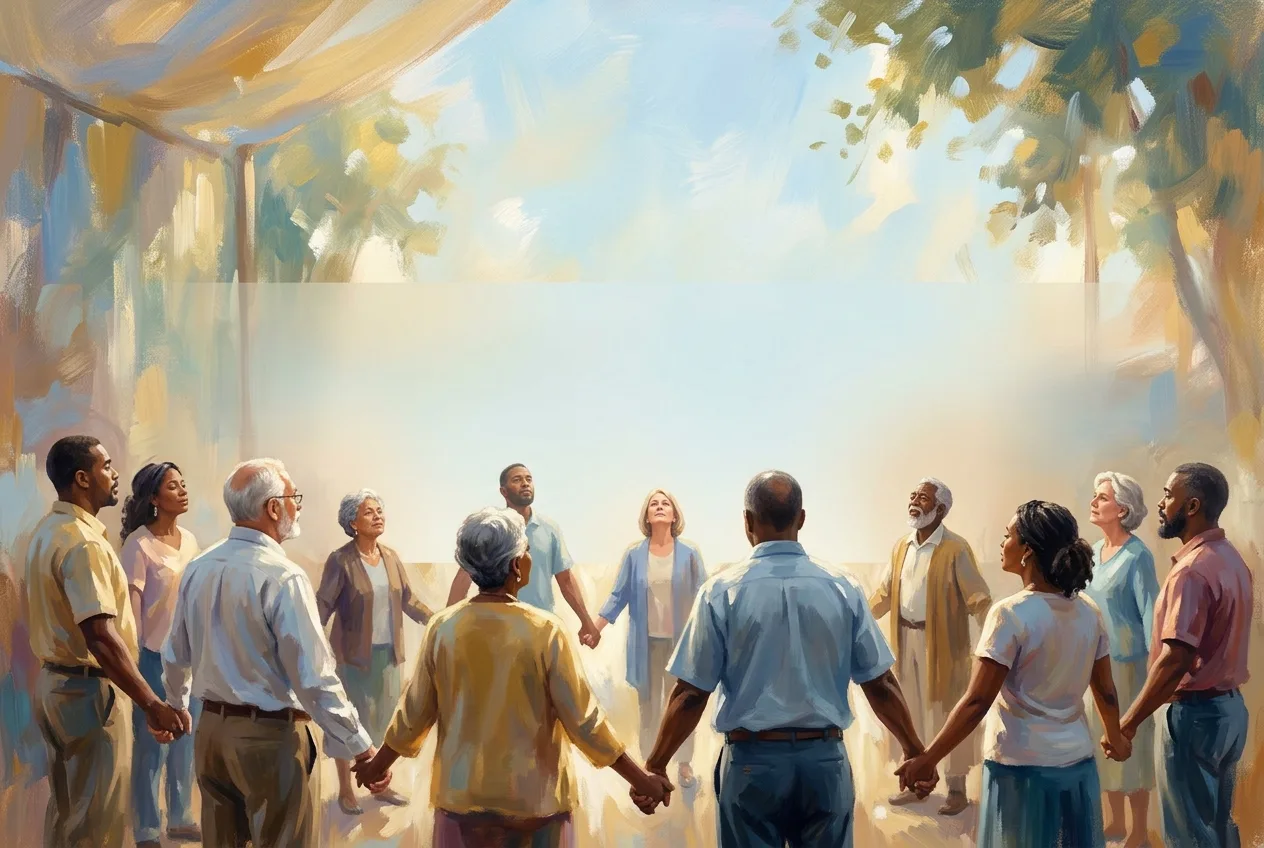
Encouraging sermon topics for progressive churches. Congregation gathered in a circle holding hands in a moment of communal prayer and solidarity, impressionist style, loose expressive brushstrokes, dappled natural light, painterly atmosphere

Encouraging Sermon Topics

for Progressive Churches

The word encourage comes from the Old French ‘encourager’ — to put heart into someone.
That’s a different thing from making people feel better.
It’s different from cheerfulness, from optimism, from the sermon
that reassures everyone that things will work out fine.
Encouragement, in the root sense, is what a community does
when it puts courage back into its members for the road ahead.

Progressive, affirming, and mainline congregations need encouragement of that kind more than most. The people in your pews are often doing hard things: showing up for justice work that yields slow results, staying in relationship across political fractures, holding faith while deconstructing what they were taught, grieving losses the wider culture has already moved on from. They don’t need to be told it will all be fine. They need to be reminded why they keep going.

These 50+ sermon topic ideas are organized not by abstract theme but by congregational moment — the specific situations when a church most needs courage put back into it. Each topic includes a brief angle and a scriptural anchor.

A note on "encouraging" in a progressive context
Most encouraging sermon content available online treats encouragement as personal comfort: help the individual find peace, overcome fear, trust God’s plan. That’s not wrong, but it’s incomplete. The prophets encouraged Israel not by promising smooth circumstances but by insisting the work of justice was worth continuing. Paul encouraged the early church not by telling them suffering would end soon but by arguing it was happening within a larger story. The most encouraging preaching for progressive congregations holds both: honest acknowledgment of how hard things are, and a clear reason to keep going.

When the Congregation Is Exhausted by Justice Work

Activist and justice-oriented congregations experience a specific kind of fatigue: the work is urgent, the results are slow, and the cost is real. These sermons don’t minimize the exhaustion. They name it, locate it in tradition, and give the congregation something to hold onto in the middle of it.
  • Those who wait upon the Lord —  Isaiah’s ‘mounting up with wings’ comes after waiting, not before striving. What does faithful waiting look like when you’re burned out — and is it different from giving up?  [Isaiah 40:28–31]
  • The long arc —  The prophets didn’t see the outcomes of their work. Neither did most of the people in Hebrews 11. What does it mean to act faithfully without seeing results?  [Hebrews 11:39–40]
  • Elijah under the broom tree —  The prophet who has done everything and is done. God’s response: sleep, food, water. Rest as a precondition for re-engagement, not a failure of commitment.  [1 Kings 19:4–8]
  • Do not grow weary in doing good —  Paul’s instruction to the Galatians: the harvest comes, but not always on your timeline. A sermon on fidelity without reward.  [Galatians 6:9]
  • The cloud of witnesses —  We are not the first people to do this work. Who are the witnesses that run alongside your congregation? Name them from your own tradition and community.  [Hebrews 12:1]
  • Micah 6:8 as life sentence  —  Not a checklist, but a vocation: to do justice, love kindness, and walk humbly. A sermon on how you sustain a life organized around those three things.  [Micah 6:8]
Pastoral Note:
Don’t rush to the hope. Stay with the exhaustion long enough for the congregation to feel recognized, then offer the tradition’s word into it. Premature encouragement feels like dismissal.

When the News Is Heavy and the World Feels Overwhelming

Election seasons, national tragedies, climate grief, political fear — congregations sometimes arrive on Sunday morning already carrying more than they can hold. These sermons don’t pretend the weight isn’t real. They offer something to stand on within it.
  • Psalm 46 and the grammar of refuge —  The earth gives way, the mountains fall into the sea — and still, God is our refuge. A sermon on what it means to claim that in a moment when the earth is, in fact, giving way.  [Psalm 46:1–2]
  • The Magnificat as political document —  Mary’s song is about a world being turned upside down. It is not comfort for the comfortable. For whom is this news actually good, and why does that matter?  [Luke 1:46–55]
  • Do not be afraid: which one? —  The most repeated command in scripture is also the one that most needs unpacking. What kind of fear is being addressed — and what is the alternative being offered?  [Isaiah 41:10]
  • The peace that passes understanding —  Not the peace that comes from good circumstances, but the peace that holds within bad ones. What Paul is and isn’t promising in Philippians 4.  [Philippians 4:7]
  • Creation’s groaning and the shape of hope —  Romans 8 as climate grief sermon: all creation groans, and the Spirit groans with us. Hope that doesn’t deny what is, but holds it within something larger.  [Romans 8:22–25]
  • The prophet’s lament and the prophet’s staying  —  Jeremiah wept and kept preaching. Lamentations mourns and keeps praying. What does it mean to stay engaged when staying engaged hurts?  [Lamentations 3:19–26]
Pastoral Note:
These sermons should name what is happening in the world specifically enough that the congregation knows you’ve been paying attention. Vague hope for vague difficulty doesn’t land.

When the Congregation Is in Conflict or Division

Every congregation navigates conflict. For progressive churches — often navigating doctrinal transition, demographic change, or significant decisions about identity and affirmation — internal conflict can be particularly painful. These sermons hold the congregation’s unity without papering over real disagreement.
  • The council at Jerusalem —  The early church’s first major conflict — resolved through argument, discernment, and a letter. We have always figured out hard things together, and it has always been messy.  [Acts 15:1–21]
  • Speak the truth in love —  Paul’s instruction as framework for congregational conflict: truth and love are not opposites. Which one does this congregation tend to sacrifice for the other?  [Ephesians 4:15]
  • The body with many parts —  Not every part of the body does the same thing. What does it mean to remain one body when members disagree, hold different gifts, or see the world differently?  [1 Corinthians 12:12–27]
  • Before you bring your gift to the altar —  Jesus’s instruction to be reconciled before worship. A sermon on the order of operations: relationship before ritual.  [Matthew 5:23–24]
  • The unity we are called to — and what it isn’t —  Unity is not uniformity. The New Testament church disagreed constantly. What is the unity that holds disagreeing people together, and what destroys it?  [Ephesians 4:3–6]
  • Beloved community as practice, not destination  —  Howard Thurman’s vision: not a community that has arrived at harmony, but one that keeps choosing each other. What does that look like on a difficult Sunday?  [John 13:34–35]
Pastoral Note:
Conflict sermons should not take sides. Name the pain of division honestly, hold the congregation to its stated values, and leave room for the process to continue after the service ends.

When Members Are Navigating Deconstruction or Faith Transition

Progressive congregations often include people in various stages of faith transition: questioning inherited beliefs, leaving evangelical backgrounds, or rebuilding a faith that can hold their questions. These sermons offer encouragement to people who are afraid their doubts make them unwelcome.
  • Doubting Thomas as patron saint —  Thomas doesn’t believe until he sees. Jesus shows up anyway, shows him the wounds, and calls him. Doubt is not disqualifying — it is met.  [John 20:24–29]
  • The disciples on the road to Emmaus —  They had given up and were walking away. Jesus walks with them without revealing himself, lets them tell their story of disappointment, and eventually opens scripture in a new way. This is the shape of accompaniment through deconstruction.  [Luke 24:13–35]
  • Wrestling until daybreak —  Jacob wrestles with God all night, refuses to let go, and walks away limping with a new name. The limp is not a failure — it is the mark of encounter.  [Genesis 32:22–32]
  • Can I still call myself a Christian? —  A direct sermon for people who are asking this question. What is essential, what is cultural accretion, and what does the tradition actually require?  [1 Corinthians 15:1–4]
  • The mystics who also doubted —  John of the Cross, Teresa of Ávila, Thomas Merton, Howard Thurman — the great spiritual directors of the tradition were not people of untroubled faith. Company in the dark.  [Psalm 22:1–2]
  • New wineskins  —  Jesus’s image of new containers for new wine. Not a rejection of tradition, but an insistence that living faith requires living forms. For congregations navigating change.  [Mark 2:22]
Pastoral Note:
These sermons should resist the urge to resolve the questions. The encouragement is in staying with the questions honestly — and making clear the congregation is a safe place to do that.

After Loss: Communal Grief and Collective Trauma

When a congregation has experienced significant loss — a member’s death, a tragedy in the community, the closure of a beloved program, a pastoral transition — it needs sermons that name what has happened, hold space for grief, and offer genuine (not premature) hope.
  • Lament as faithful act —  The psalms of lament are not failures of faith — they are faith’s honest face. A sermon on why the church needs to recover the practice of communal lament.  [Psalm 13]
  • Jesus wept —  The shortest verse in scripture. God does not stand outside grief and offer comfort from a distance. God enters it. This is enough.  [John 11:35]
  • Steadfast love in the middle of ruin —  Lamentations was written in the immediate aftermath of Jerusalem’s destruction. The author is sitting in the rubble. The claim of steadfast love is not naive — it is made from the hardest possible place.  [Lamentations 3:22–23]
  • We do not grieve as those without hope —  Paul’s careful phrasing: not ‘we do not grieve,’ but ‘not as those without hope.’ What is the hope that coexists with grief rather than canceling it?  [1 Thessalonians 4:13]
  • The women who stayed at the cross —  When the disciples scattered, the women remained. A sermon on the courage of presence — staying when staying is costly.  [Mark 15:40–41]
  • New creation, not erasure  —  Resurrection is not a return to how things were. It is something genuinely new, which means the loss is real and what follows is not a reversal of it. Hope for congregations that need to grieve and move forward simultaneously.  [Revelation 21:4–5]
Pastoral Note:
Grief sermons should not end with resolution. They should end with presence — yours, the congregation’s, and whatever you believe about God’s. The encouragement is in not being left alone with it.

For Advent, Lent & Liturgical Seasons of Waiting

The liturgical year builds encouragement into its structure: seasons of waiting, of return, of darkness before light. These sermons use the season itself as the frame, trusting the liturgical calendar to carry theological weight the congregation already feels.
  • Advent as honest waiting —  Not nostalgic Christmas preparation but genuine longing for a world that isn’t here yet. What does it mean to wait with integrity — hoping without pretending?  [Isaiah 64:1–4]
  • The pregnant pause before the promise —  Elizabeth’s pregnancy, Mary’s pregnancy, the whole of Advent — something is coming that isn’t here yet. How do we live faithfully in the meantime?  [Luke 1:39–45]
  • Giving up certainty for Lent —  A Lenten sermon on the spiritual practice of not-knowing. What becomes possible when we stop defending our positions and start listening?  [Philippians 3:7–9]
  • Ash Wednesday: the dignity of dust —  We are mortal, and this is not shameful. A sermon on humility, honesty, and the strange gift of being reminded we are finite.  [Genesis 3:19]
  • Palm Sunday: the courage to enter —  Jesus enters Jerusalem knowing what is coming. A sermon on prophetic courage — showing up for the difficult thing because it is right, not because it is safe.  [Mark 11:1–11]
  • Easter for skeptics: what we can say  —  A resurrection sermon that doesn’t require leaving your questions at the door. What is the irreducible claim of Easter, and why does it matter?  [1 Corinthians 15:17–20]
Pastoral Note:
Liturgical encouragement sermons work because the season does half the work. Trust the shared rhythm. You don’t need to explain Advent — your congregation already lives in it.

When the Church Itself Needs Encouragement About Its Own Future

Declining attendance, budget stress, questions about relevance, pastoral transitions — many mainline congregations carry anxiety about whether they have a future. These sermons address that anxiety directly, from within the tradition rather than around it.
  • The mustard seed church —  Jesus’s parable is specifically about something that starts small and becomes large, slowly. A sermon on faithfulness in a congregation that is not growing the way it once did.  [Mark 4:30–32]
  • What is the church for? —  Acts 2:42–47 as mission statement: teaching, fellowship, breaking bread, prayer, and serving the neighborhood. When a congregation returns to this, it finds out whether it still wants to exist.  [Acts 2:42–47]
  • The remnant theology of Isaiah —  Not every tree, but a stump. Not every branch, but a shoot. The prophetic tradition has always known how to be faithful in smallness. What do your congregation’s faithful remnant teach you?  [Isaiah 11:1]
  • Why we still gather —  The theological case for embodied community in a digital, distracted age. What can only happen when bodies are in a room together, and is it worth showing up for?  [Hebrews 10:24–25]
  • Jeremiah’s letter to the exiles —  Build houses, plant gardens, seek the welfare of the city where you are. A sermon for a congregation that feels displaced from its former influence but is called to faithfulness in the present.  [Jeremiah 29:4–7]
  • The gifts we almost missed  —  A sermon taking stock of what this specific congregation actually does well — its particular gifts, its place in the neighborhood, the things only it can offer. Encouragement grounded in the particular.  [1 Corinthians 12:4–7]
Pastoral Note:
These sermons require pastoral courage to preach. Name the anxiety directly before offering the word into it. A congregation that feels seen in its fear is more ready to hear hope than one that senses the pastor is avoiding the real conversation.

A Note on the Craft of Encouragement

The sermons that actually encourage — the ones people carry with them for years — share a common structure. They go toward the difficulty, not around it. They stay in the hard place long enough for the congregation to feel recognized. And then, from within that place, they offer the word of the tradition: not as an escape hatch, but as a reason to remain.

The most encouraging passages in scripture are also the most honest ones. Isaiah 40 is written for people who have been in exile for a generation. Lamentations is written sitting in rubble. Romans 8 is written for a persecuted community. None of them pretend the difficulty isn’t real. All of them offer something to hold onto within it. Follow that pattern, and your congregation will feel encouraged in the way that actually lasts.

Need help developing any of these into a full sermon?

PCM Lumen is an AI writing tool built for progressive ministry — trained to assist with sermon outlining, manuscript drafting, and theological reflection without losing your voice or your tradition’s integrity. Pick a topic and a congregational moment, and let Lumen help you shape it into something worth preaching.
PCM Lumen logo with sun icon and gradient purple pink background, vertical layout
14-day free trial - no credit card required

More Preaching Resources from Progressive Church Media

Frequently Asked Questions

What are good encouraging sermon topics?
The best encouraging sermon topics for progressive and mainline congregations are organized around the specific moments when a church needs courage: after communal loss or tragedy, during political anxiety and election seasons, when justice workers are burning out, when the congregation is in conflict, when members are navigating deconstruction, and during seasonal transitions like Advent and Lent. Topics that work well include the Sermon on the Mount as a manifesto for the long haul, lament as spiritual resilience, the prophets' pattern of truth-telling and endurance, and resurrection as a practice rather than just a doctrine.

What is an encouraging sermon?
An encouraging sermon gives courage — which is different from making people feel comfortable or reassured. The word encourage comes from the French for 'to put heart into.' The most encouraging sermons for progressive congregations acknowledge the weight of the moment honestly, ground the congregation in a tradition of faithful endurance, and offer a clear invitation forward. They don't rush past grief or difficulty; they give the congregation something to hold onto within it.

How do you preach an encouraging sermon without being superficial?
Preach toward the difficulty, not around it. Superficial encouragement names the problem lightly and resolves it quickly. Genuine encouragement stays with the congregation in the hard place long enough for the scriptural word to actually land. This usually means spending more time in lament and honest acknowledgment than in resolution. The most encouraging sermons in the prophetic tradition — Isaiah 40, Psalm 22, Romans 8 — are honest about how heavy things are before they offer hope. Follow that pattern.

What Bible passages are good for encouragement?
For progressive and mainline congregations, the most useful encouragement passages include: Isaiah 40:28-31 (those who wait upon the Lord), Romans 8:18-25 (creation's groaning and hope), Psalm 46 (God as refuge in upheaval), Hebrews 12:1-2 (the cloud of witnesses), Lamentations 3:19-26 (steadfast love in the middle of ruin), Micah 6:8 (what is required of us), and the Beatitudes in Matthew 5 (blessedness in unexpected places). These passages offer honest hope rather than cheap comfort.

Copyright © 2026 Progressive Church Media
Visa
MC
AMEX
Discover