No products in the cart.
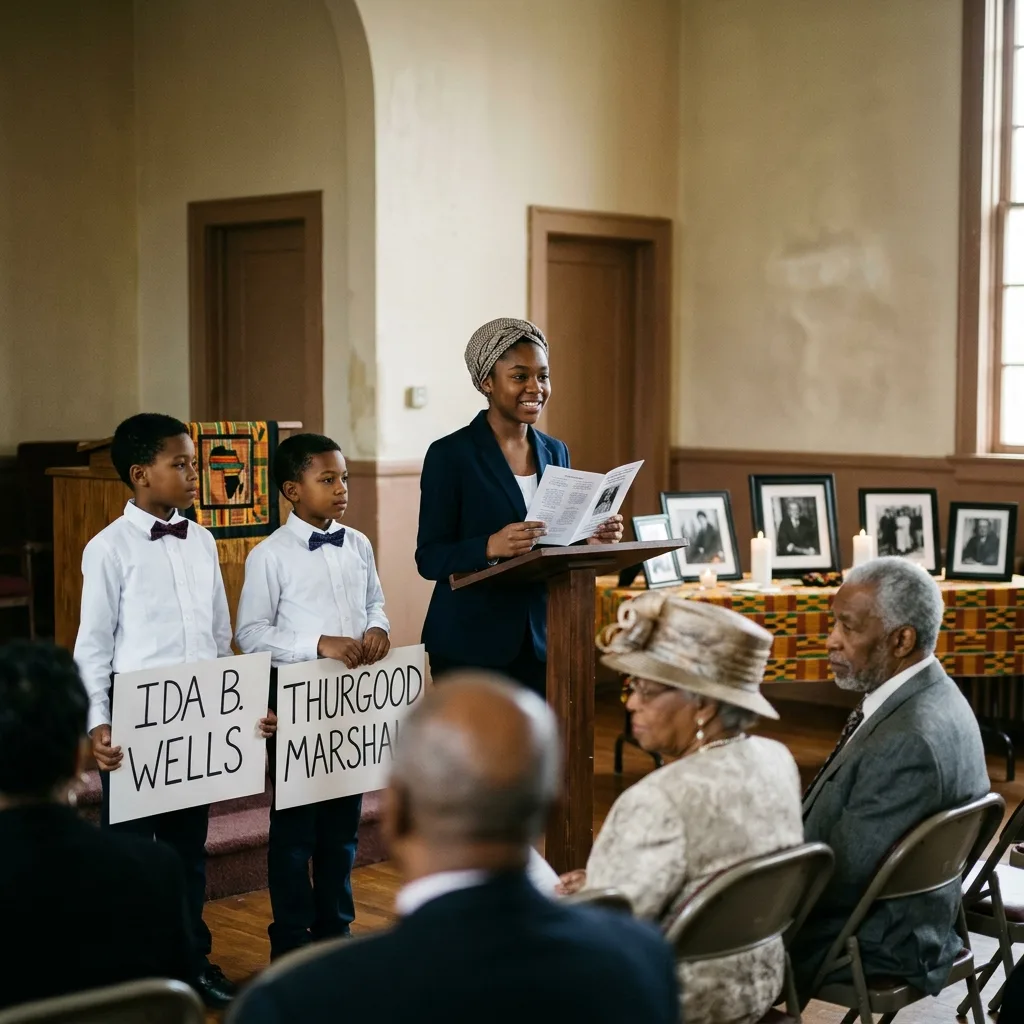
A Black History program is one of the great traditions of the Black church: a Sunday afternoon or a whole service given to remembering, with a welcome, the Occasion, scripture, songs, speeches, and the young people of the church taking their turn at the front. If your committee is planning one this February, this page has what you need to build it: a sample order of program, welcome speeches you can read as written, a sample Occasion, short speeches, themes, and ideas for youth.
Everything here is free to use and adapt. Put your church's name in the brackets, change what doesn't fit your people, and keep what does.
This order runs about 75 to 90 minutes. Shorten it by dropping the second musical selection and keeping the speaker to 20 minutes.
| Part | What happens |
|---|---|
| Prelude | Spirituals as people gather: “Wade in the Water,” “Steal Away,” “There Is a Balm in Gilead.” |
| Welcome | A member, officer, or young person welcomes everyone (scripts below). |
| Call to worship | A responsive reading. Use the scripture responsive reading for Black History Month, or the call to worship in our free liturgy. |
| Hymn | “Lift Every Voice and Sing.” By long tradition the congregation stands. |
| Scripture | One or two readings. Exodus 3:7–8, Psalm 68:31, and Hebrews 12:1 are favorites; see more Bible verses for Black History Month, in KJV and NRSVue. |
| Prayer | An opening prayer by a deacon, elder, or mother of the church. |
| The Occasion | A short statement of why the church gathers today (sample below). |
| Youth presentation | Living history, short speeches, or recitations (ideas below). |
| Musical selection | Choir, soloist, or a guest choir from a nearby church or HBCU. |
| Speaker | Introduction of the speaker, then the address or sermon (20 to 30 minutes). |
| Remembrance | A roll call of ancestors: names read aloud, with the congregation responding, “We remember.” Light a candle for each if you like. |
| Offering | Consider giving the offering to an HBCU scholarship or a local Black-led organization, and say so. |
| Acknowledgments | Thank the committee, the speaker, the musicians, and the cooks. |
| Benediction | Closing prayer and blessing. |
| Repast | Fellowship meal. In many churches this is where the history keeps getting told. |
Want full prayers and a complete liturgy instead of a program format? Our free Black History Month prayers and liturgy includes a call to worship, a litany of the cloud of witnesses, a confession, and prayers of the people.
Three welcomes, from shortest to longest. Each one is written to be read aloud exactly as it stands.
Good morning, and welcome to [Church Name]'s Black History program. Whether this is your first time with us or you have sat in these pews for fifty years, we are glad you are here. Today we remember, we give thanks, and we celebrate the people of African descent whose faith and courage made a way out of no way. So lift your voices with us. Welcome.
Giving honor to God, to our pastor, [Name], to our program committee, and to every one of you: good morning, and welcome to [Church Name].
Every February we set aside time to remember. Not because one month is enough, because it isn't, but because a people who forget where they came from lose sight of where God is leading them. The historian Carter G. Woodson began this observance in 1926 so that our history would be taught on purpose instead of left to chance. We are keeping that promise today.
This afternoon we will hear the stories of people who walked by faith when they could not walk freely: preachers and organizers, singers and sharecroppers, mothers of the church and young people who would not wait. We will sing the songs they sang. And we will ask what their witness asks of us now.
If you are visiting, you are not a guest at someone else's celebration. You are part of this family for the day. Whoever you are, wherever you come from, and whomever you love, there is room for you here.
So settle in, turn to your neighbor, and tell them, “I'm glad you came.” Welcome to [Church Name].
Good morning, church! My name is [Name], and on behalf of the youth of [Church Name], welcome to our Black History program.
We've been learning about the people who came before us: people who prayed, marched, sang, and built churches when the world told them no. They made a way for us. Today we want to say thank you to them, and to you, the elders who taught us their names. We're glad you're here. Let's celebrate!
In many Black churches, the Occasion is a short statement read near the start of the program that tells everyone why the church has gathered. Here is one you can use or adapt.
Each February, [Church Name] sets aside this day to give thanks to God for the history, faith, and witness of people of African descent. We gather to remember those who made a way out of no way, to tell their stories to the next generation, and to take up again the work of justice they began.
When Israel crossed the Jordan, God told the people to set up stones, so that when their children asked, “What mean ye by these stones?” they would have an answer. This program is our answer. We remember, so that our children will know.
Each of these runs about a minute when read aloud, which makes them a good fit for youth, for a reader's theater with several voices, or for a series across the Sundays of February.
Richard Allen was born into slavery in 1760. As a young man he came to faith at a Methodist meeting, began to preach, and bought his own freedom. In Philadelphia, he and other Black Methodists worshiped at St. George's Church, until one Sunday when white church officials pulled Black worshipers up off their knees in the middle of prayer. They finished praying, and then they walked out together.
Allen did not leave the faith. He built a church. Mother Bethel opened in 1794, and in 1816 Allen became the first bishop of the African Methodist Episcopal Church, the first independent Black denomination in the United States. When the church would not make room, Richard Allen made room, and the AME Church has been making room ever since.
Fannie Lou Hamer was a sharecropper in Mississippi, the youngest of twenty children. In 1962, at the age of 44, she tried to register to vote, and she was thrown off the plantation where she had worked for years. In 1963 she was arrested and savagely beaten in a jail in Winona, Mississippi.
She kept going. She helped found the Mississippi Freedom Democratic Party, and in 1964 she testified before the national Democratic convention about what it cost a Black woman in Mississippi to try to vote, and the whole country heard her. She was a woman of deep faith, known for leading “This Little Light of Mine” at mass meetings. She said she was sick and tired of being sick and tired, and she turned that weariness into work.
Bayard Rustin grew up in West Chester, Pennsylvania, raised by his grandparents and shaped by Quaker faith and its commitment to nonviolence. He spent his life organizing. He advised Dr. King on nonviolent resistance, and he was the chief organizer of the 1963 March on Washington, where about a quarter of a million people gathered.
Rustin was also a gay man, and he paid for it. Opponents used his sexuality to attack the movement, and some allies kept him in the background. He kept working anyway. In 2013, he was awarded the Presidential Medal of Freedom. His life reminds the church that the freedom movement was built by people the church was often slow to welcome, and that every one of them belongs in the story we tell.
Writing your own? Keep it to one person, one moment, and one meaning, in about 150 to 250 words. End by connecting their witness to your congregation today. Check dates and quotes against a trusted source such as the National Museum of African American History and Culture or the Association for the Study of African American Life and History (ASALH) before anyone reads them aloud.
A theme gives the committee, the speaker, and the youth something to build around. Each of these comes with a scripture text.
Each year ASALH, the organization Carter G. Woodson founded, announces a national theme for Black History Month. Check asalh.org if your committee would like to use it.
These are in the public domain, so you can print them in a bulletin or put them on screen without permission.
Before you print: Dr. King's speeches and sermons, and poems by Langston Hughes, Maya Angelou, and most other twentieth-century writers, are still under copyright. A short phrase is fine; printing a full poem or a long excerpt needs permission or a license. And many quotes attributed to Harriet Tubman online have no documented source, so check before you print one.
A Black History program in a mostly white church is worth doing, and worth doing carefully. Don't ask your few Black members to produce it for everyone else. Invite Black preachers, historians, and musicians, and pay them what you would pay any guest. Tell the truth about your own congregation's history, including any part of it that was on the wrong side. The prayers and liturgy page includes a prayer of confession written for exactly this.
Instant-download welcome videos, PowerPoint slides, and flyers, designed for Black History Month and ready for this Sunday's screens and bulletins.
Welcome to Church Videos → Welcome to Church Flyer →

✅ Inclusive ✅ Downloadable instantly ✅ Bilingual options ✅ Affirming
Greet everyone, name the church and the occasion, and say why you have gathered: to remember, give thanks for, and celebrate the faith and witness of people of African descent. Make visitors feel included rather than like spectators, and keep it under two minutes. This page has three welcomes you can read as written: a short one, a standard one, and one for a young person.
A common order is prelude, welcome, call to worship, “Lift Every Voice and Sing,” scripture, prayer, the Occasion, a youth presentation, a musical selection, the speaker, a roll call of ancestors, the offering, acknowledgments, the benediction, and a repast. Plan on 75 to 90 minutes.
Strong themes pair a phrase with a scripture text, such as “What Mean Ye by These Stones?” (Joshua 4:6–7), “So Great a Cloud of Witnesses” (Hebrews 12:1), “Let Justice Roll Down” (Amos 5:24), or “Joy Cometh in the Morning” (Psalm 30:5). ASALH, the organization Carter G. Woodson founded, also announces a national theme each year.
The Occasion is a short statement, usually read near the start of the program, that explains why the church has gathered. For a Black History program it names the purpose of the day, often with a scripture, in two or three short paragraphs.
For youth or a series of speakers, about one minute, or 150 to 250 words: one person, one moment, and what it means for the church today. A main speaker or sermon usually runs 20 to 30 minutes.
Short phrases are fine, but Dr. King's speeches and poems by Maya Angelou and Langston Hughes are under copyright, so printing or projecting full texts needs permission or a license. Frederick Douglass, Paul Laurence Dunbar, Frances Ellen Watkins Harper, “Lift Every Voice and Sing,” and the traditional spirituals are in the public domain.