No products in the cart.
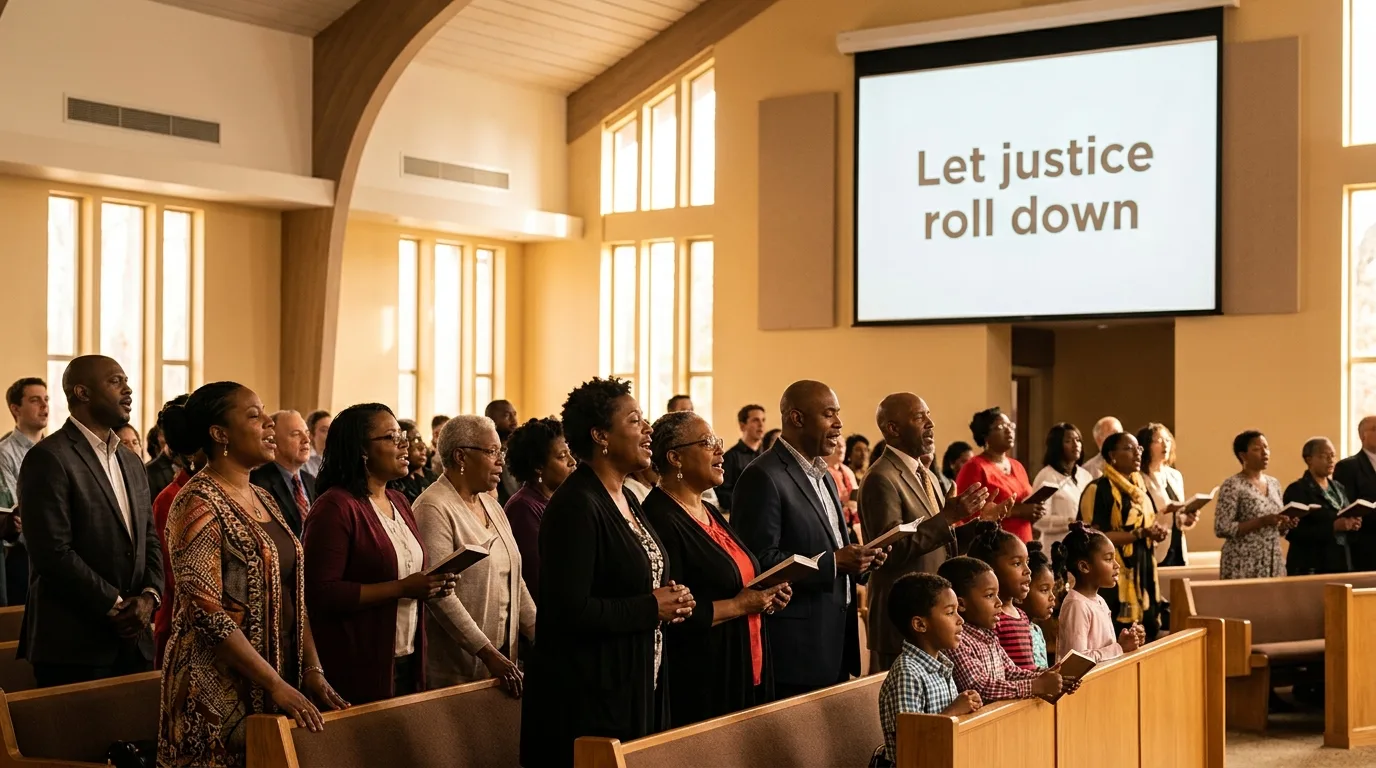
Martin Luther King Jr. Day is Monday, January 18, 2027. The Sunday before it — January 17 — is when most congregations mark the day in worship, and it is also the Second Sunday after the Epiphany, Year B. The appointed readings turn out to be unusually fit for the occasion: Samuel called in the night, a psalm that insists every body is fearfully and wonderfully made, and Philip’s answer to “Can anything good come out of Nazareth?” — come and see.
This page carries prayers for MLK Sunday you can use as they are — a call to worship, a confession, a litany of remembrance and resolve, and prayers of the people — and a free, complete liturgy built around them, with an interfaith form for community services. Everything here is written for progressive, affirming, and mainline congregations, in expansive language, and it does not ask you to leave the lectionary.
The federal holiday is the third Monday of January. Churches observe it on the Sunday before, which moves each year: January 17 in 2027, January 16 in 2028. Because the holiday lands in the season after Epiphany, the liturgical color is green and the Sunday has its own lectionary readings — the day is not a feast with propers of its own, which means the congregation keeps its ordinary rhythm and lets the readings do the work. In Year B they do it well.
Some towns also hold a community or interfaith service on the Sunday afternoon or on the Monday itself, often hosted by a Black congregation or a ministerial alliance. If your church is invited, go; the interfaith litany below is written for that room.
The temptation is nostalgia: a King safely in the past tense, quoted on one line and agreed with by everyone in the room. It is comfortable, and it is the opposite of what he asked of the church. The Letter from Birmingham Jail was addressed to eight white clergymen who considered themselves allies and had just called his campaign unwise and untimely. They were moderates. For most mainline congregations, they were us.
So the prayers on this page do three things a generic MLK resource usually will not. The confession puts the congregation inside the church King wrote to, rather than beside him. The litany remembers the people whose names are not on holidays, and leaves a line for your own town’s history. And the prayers of the people name what the day is about in 2027 — voting, policing, what children are taught — rather than in 1963.
One practical honesty: Dr. King’s speeches, sermons, and the Letter are under copyright, and the King estate enforces it. Nothing on this page reproduces them. Where the confession draws on the Letter it paraphrases, and says so. What you will find here in full is scripture and public-domain hymns and spirituals — which were the movement’s own music before they were anyone’s illustration.
The complete liturgy is free to download as a PDF and an editable Word document. Eight pages: before-you-begin notes, guidance for the worship planner, practical notes on music, the offering, children’s time, and pushback; a gathering with welcome, call to worship, and invocation; a scripture table pairing the appointed readings with alternates from Amos, Micah, Isaiah 58, and Luke 4; confession and assurance; the litany; prayers of the people; music notes; a commissioning for a Monday day of service; and a benediction. A closing section covers particular services — an interfaith form of the litany, a short prayer for the holiday itself, and a spoken word for a predominantly white congregation to precede the confession.
Every element in the Word file is a plain paragraph, so you can copy any prayer straight into your own bulletin or slide template. No attribution is required.
Download the free MLK Sunday liturgy
The four spoken pieces at the heart of the liturgy, ready to use. “One” is the leader; “All” is the congregation.
Psalm 139 and John 1 in echo.
One: Holy One, you have searched us and known us.
All: You knit us together. We are fearfully and wonderfully made — every one of us.
One: Some of us were told that about ourselves. Some of us were told the opposite — by law, by custom, by people who called themselves Christian.
All: We are fearfully and wonderfully made — every one of us.
One: Can anything good come out of Nazareth? Philip did not argue. He said: come and see.
All: We have come. Open our eyes, and let us see.
One: Come, let us worship the God who calls in the night and waits for someone to answer.
All: Speak, Holy One. Your servants are listening.
After the Letter from Birmingham Jail, paraphrased. Prayed in unison.
God of justice, we confess that we have been the moderate church.
We have preferred a quiet peace to a just one.
We have said “not yet” to people who had already waited too long,
and called our timidity wisdom.
We have admired Dr. King on one Sunday in January
and ignored what he asked of us the other fifty-one.
We have wanted the dream without the march,
the mountaintop without the jail,
the beloved community without the cost of building it.
Forgive us. Disturb our peace.
Make us the church he wrote to, and hoped for, and did not find.
Silence is kept. Let it be longer than is comfortable.
One: Hear the good news: God did not stop calling Samuel because he answered the wrong door three times. God called a fourth time, and Samuel said, speak. The invitation has not been withdrawn from you. It has been repeated.
All: Speak, Holy One. We are listening.
One: You are forgiven. You are not too late. Rise, and answer.
A candle may be lit at the first line and left burning through the service.
One: We remember a preacher’s son from Atlanta, who read the prophets and believed them.
All: We remember, and we will not look away.
One: We remember the ones whose names are not on holidays: the marchers; the maids and the laborers who walked to work for a year in Montgomery; the children who faced the dogs and the fire hoses in Birmingham; the ones who registered voters in Mississippi and were buried for it.
All: We remember, and we will not look away.
One: We remember that the movement was a church before it was a headline — that it began in sanctuaries and mass meetings, in songs sung on the way to jail.
All: We remember, and we will not look away.
One: We remember what happened here, in this place: [name the local history — the school, the counter, the church, the street].
All: We remember, and we will not look away.
One: We remember that Dr. King was not loved while he lived — that the polls turned against him, that pulpits went quiet, that moderate voices asked him to wait.
All: We remember, and we will not look away.
One: We remember that he was killed at thirty-nine, in Memphis, standing with sanitation workers — and that the work he was doing that week is not finished.
All: We remember, and we will not look away.
One: And we resolve: to be the church that shows up before the cameras do, and stays after they leave.
All: We will not look away. We will come and see. Amen.
The response is Amos 5:24, the verse King quoted more than any other.
One: God who searches and knows, we bring you a nation still arguing about who counts. For every person whose vote is made harder to cast, whose neighborhood is over-policed and under-served, whose child is taught a history with the hard parts removed —
All: Let justice roll down.
One: For Black congregations and Black clergy, who have carried this witness for generations without waiting for the rest of us to catch up —
All: Let justice roll down.
One: For everyone in this room who has been told they were not what God had in mind — by race, by body, by who they love, by where they were born —
All: Let justice roll down.
One: For those who hold power over housing, courts, schools, and borders, that they may prefer justice to order —
All: Let justice roll down.
One: For this congregation: make us uncomfortable in the right places, and brave in the right moments.
All: Let justice roll down like waters, and righteousness like an ever-flowing stream. Amen.
The benediction, the offering sentence, the commissioning, the invocation, and the welcome are in the full liturgy.
The appointed readings for January 17, 2027, and why each one carries the day:
For a themed service, the alternates are the ones King himself reached for: Amos 5:18–24 (let justice roll down — read the whole passage; God is rejecting worship that is not attached to justice), Micah 6:6–8, Isaiah 58:6–12 (the repairer of the breach — a good sending text), and Luke 4:16–21.
“Lift Every Voice and Sing” is the hymn of the day. James Weldon Johnson wrote the words in 1900 and his brother J. Rosamond Johnson the music; it is in the public domain. Sing all three verses, standing. The third verse is the prayer, and a congregation that stops after the first has sung a march and skipped the church.
“We Shall Overcome” entered the public domain after a 2018 court settlement. Sing it linked, as it was sung, and do not rush the last verse. Also free to sing, and sung on the way to jail long before they were anyone’s illustration: “This Little Light of Mine,” “Ain’t Gonna Let Nobody Turn Me Around,” “Go Down, Moses,” “Wade in the Water,” “Woke Up This Morning.”
Say so from the front. The Letter from Birmingham Jail was written to white clergy who considered themselves friends of the movement; the confession above is written for the church he was writing to. That is not an accusation. It is the reason the liturgy takes the shape it does, and naming it before the prayer is what keeps the prayer from sounding like it was about someone else.
Two more things worth deciding before Sunday. Do not invite a Black congregation or preacher for this one Sunday unless a relationship already exists the other fifty-one; a guest brought in for the holiday will know exactly what is happening. And direct the offering, or a second offering, to a local organization doing the work the prayers name — voting access, bail, housing, legal aid — and say where it is going before the plates go out.
Many MLK observances are ecumenical or interfaith, and Christ-specific language excludes people who came in good faith. The full liturgy includes an interfaith form of the litany that keeps the One/All structure and the same response, names the movement’s Jewish, Unitarian, Muslim, and Catholic marchers alongside the Baptists and Methodists, and lets each tradition resolve in its own language. It also carries a short prayer for the Monday — for a day of service, a march, or the family table.
Slides, social graphics, flyers, and backgrounds for the day — including the March on Washington, Legacy of Dr. King, and Day On sets — are gathered on the MLK Day worship graphics page and in the Dr. Martin Luther King Jr. collection. If your congregation keeps Watch Night on New Year’s Eve, the Watch Night service guide covers Freedom’s Eve, two weeks before this Sunday. Also see our free liturgy for Black History Month, and Black History program ideas for church if your congregation holds a program.
PCM Complete members download every MLK set, and everything else in the library, for one annual fee.
Writing your own sermon or prayers for the day? PCM Lumen drafts sermons, liturgy, and pastoral letters in a progressive voice, and PCM Imago generates worship images with affirming presets built in.
When is MLK Sunday in 2027?
Sunday, January 17, 2027 — the day before the federal holiday on Monday, January 18. It is the Second Sunday after the Epiphany in Year B of the Revised Common Lectionary, and the liturgical color is green.
Do the lectionary readings for that Sunday work for an MLK service?
Yes, unusually well: 1 Samuel 3 (God calling Samuel in the night), Psalm 139 (“fearfully and wonderfully made”), 1 Corinthians 6, and John 1:43–51 (“Can anything good come out of Nazareth? Come and see”). The liturgy on this page is built on them, so a congregation does not have to leave the lectionary to mark the day.
Can we quote Dr. King in worship?
His speeches, sermons, and the Letter from Birmingham Jail are under copyright and the King estate enforces it. Short phrases in common currency are fine; longer readings should come from a licensed source, credited. This liturgy paraphrases the Letter rather than quoting it, and uses scripture and public-domain spirituals for the words it prints in full.
Is “Lift Every Voice and Sing” in the public domain?
Yes. The words (James Weldon Johnson) and music (J. Rosamond Johnson) date from 1900. “We Shall Overcome” is also in the public domain following a 2018 court settlement.
Is the liturgy really free?
Yes. Download it as a PDF and an editable Word document, print it, project it, and adapt it. No attribution is required, though it is always welcome.
Can it be used in an interfaith service?
The full liturgy includes an interfaith form of the litany of remembrance and resolve, written for community services where Christ-specific language would exclude people gathered in good faith.